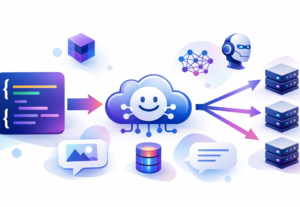
The RAG (Retrival-Increased Generation), or generation augmented by recovery, is a technique that pairs a large language model with an external knowledge base to produce accurate and quirky responses. The system first searches for documents relevant to the question asked, then the model formulates the answer from this specific context. Result: less hallucinations, data still up-to-date, and the possibility of interviewing your own documents in natural language without retraining the model. This is how it works in practice, in which cases it is used, and how to deploy it in 2026.
📌 Essentials
- RAG = recovery + generation : an architecture that anchors LLM on your data rather than on their training memory.
- Dominant patterns in 2026 : Agentic RAG, GraphRAG and Adaptive RAG, which gradually replace the RAG « naive ».
- RAG Market with a CAGR estimated at 44.7% of 2024-2030 according to Grand View Research.
- 60% of RAG 2026 deployments include a systematic assessment from day one.
- TPE/SME entry ticket : from 20 €/user/month with turnkey solution.
Contents: Definition • Operation • RAG vs LLM vs fine tuning • Why use RAG • Use • Trends 2026 • Five key issues • TPE/SME deployment • RAG in video and image AI • Limits • FAQ
What is RAG?
The generation increased by recoveryEnglish Retrieval-Increased Generation (abbreviated RAG), is an architecture ofAI which combines two components: an information search system and a generic language model. The engine first consults an external document base to find relevant passages in relation to the query, then the LLM uses these passages as a context to generate its response.
The term was introduced in 2020 by a team of Meta AI researchers (then Facebook AI Research) in a scientific article presenting the method as an alternative to fine tuning to integrate new knowledge into a LLM. Since then, the RAG has established itself as the standard approach to plugging in AI on a proprietary corpus without touching the weight of the model.
Une définition plus formelle : le RAG est un cadre d’AI qui enrichit la génération de texte avec une étape préalable de récupération dans une source externe, base documentaire, base vectorielle, moteur de recherche, voire graphe de connaissances. La sortie est ainsi ancrée sur des données vérifiables plutôt que sur la seule mémoire paramétrique du modèle.
RAG vs LLM standard: the key difference
Un LLM standard, comme GPT-5.4, Claude Opus 4.7, Mistral Large ou Gemini 3.1 Pro (voir notre Classification AI 2026), génère ses réponses à partir des connaissances apprises pendant l’entraînement. Ces connaissances sont figées à une date donnée et ne couvrent pas les documents internes d’une entreprise. Un système RAG, lui, va chercher l’information à la volée dans une base que vous contrôlez.
Consequence: with an LLM alone, ask « What is our turnover at T3 2025? » best gives an evasive response, at worst a hallucination. With an RAG connected to your financial reports, the answer is accurate and focused, with reference to the original document.
How does the RAG work in practice?
A RAG pipeline is based on four main steps, the technical details of which vary according to implementations but whose logic remains constant.
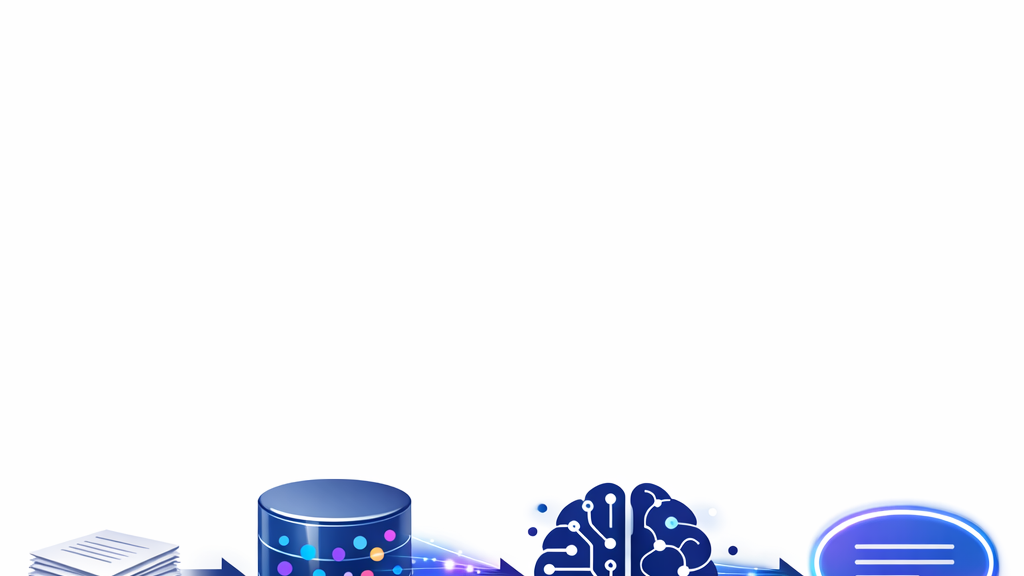
The 4 stages of the RAG pipeline
1. Indexing of documents. Les documents sources, PDF, pages web, fiches produit, contrats, comptes rendus, sont découpés en morceaux appelés chunks, usually from 200 to 1,000 tokens. Each chunk is then converted into a digital vector by a dtext-embedding-3-small dOpenAI, mistral-embed, or open source models like multilingual-e5-large). These vectors are stored in a vector base like Pinecone, Weaviate, Qdrant or extension pgvector for PostgreSQL.
2. User request. The user asks a question in natural language. This question is also converted into a vector by the same d-embedding model, to be comparable to indexed chunks.
3. Recovery. The system calculates the similarity (cosinus, scalar product or Euclidean distance) between the vector of the question and all vectors of the base, then goes up the k chunks les plus proches, typiquement entre 3 et 10. C’est la partie « R » (Retrieval) du RAG.
4. Generation. The recovered chunks are injected into the LLM prompt with the initial question. The model then produces an answer based on this specific context, usually with a statement of the type « answer only from the passages provided and quote your sources ». That's the game. « G » (Generation).
💡 The detail that changes everything: the choice of the model is more important than the final LLM on the quality of a RAG. A poorly calibrated multilingual model for French can reduce relevance from 30 to 40%. Testing several models of embedding on a sample of your corpus before industrialization is often the most profitable investment of the project.
RAG vs LLM vs fine-tuning: what differences?
Trois approches se côtoient pour adapter un modèle d’AI à un besoin spécifique. Elles ne s’opposent pas, elles se combinent même souvent, mais répondent à des problèmes différents.
| Criteria | LLM alone | RAG | Fine tuning |
|---|---|---|---|
| Fresh data | ❌ Frozen at workout | ✅ Real time | ⚠️ New cycle at each MAJ |
| Implementation cost | 💰 Low (API) | 💰💰 Moderate | 💰💰💰💰 High |
| Traceability of responses | ❌ Black box | ✅ Citable sources | ❌ Black box |
| Customizing the tone | ⚠️ Quick Via | ⚠️ Quick Via | ✅ Excellent |
| Confidentiality | ⚠️ By supplier | ✅ Possible local data | ⚠️ Weight data |
| Ideal use case | Generic creative tasks | Questions on trade data | Very specific tone or format |
In practice, we often combine the three: a generalist model, a documentary RAG, and a light fine tuning to set the tone. This hybrid approach (sometimes called RAFT, for Retrieval-Augmented Fine-Tuning) has been gaining ground in enterprise deployments since late 2025.
Why use increased generation by recovery?
The GAR brings four benefits that LLM alone cannot offer.
Freshness and customisation of data
A LLM is trained up to a given date. Beyond that, he knows nothing. The RAG allows you to connect the model to updated data in real time: intranet, CRM, documentary database, e-commerce site, support knowledge base. You update the vector base, the system responds immediately with new information, without re-training.
Reducing hallucinations
LLM tend to invent plausible but false information. By forcing the model to respond only from the recovered passages, the RAG drastically reduces this risk. The responses can also cite their sources, which is essential in the regulated areas (legal, medical, financial). Patterns « RAG corrective » and « self-reflective RAG » push even further by having the model itself evaluate the quality of its recovery before responding.
Controlled cost
Retrain or fine-tuner an LLM on proprietary data costs in GPU and expertise. A GAR works with a pre-existing generic LLM. Simply index your documents and pay API calls on demand, or auto-host an open source model via a platform like Hugging Face Inference API. For most SMEs, the gap between « Project AI inaccessible » and « POC available in a few weeks for a few hundred EUR ».
Traceability and compliance
The RAG provides an example of the exact passages used to formulate the answer. It is valuable for the audit, the GDPR, and any situation where it is necessary to justify a recommendation produced by theAI. A well designed RAG system therefore produces a response + a list of clickable sources, which no single LLM can honestly do.
In what cases is it appropriate to use the RAG?
The RAG is relevant as soon as a specific documentary corpus with a AI. The most mature cases of use in 2026:
- Internal and external customer support. A chatbot connected to the knowledge base can respond 24/7 to customers or employees, with verifiable sources. This is now the most widely used RAG use.
- Advanced documentary search. Legal, R&D or compliance teams interview thousands of contracts, patents or standards in natural language.
- Trade assistants. A commercial asks « What arguments do we have against [competitor] in the retail segment? » and receives a summary based on reports and battle cards.
- Onboarding and training. New employees interview an RAG assistant who responds to internal procedures.
- Watch and analyze. The RAG ingests press, sector reports or regulatory data and produces targeted syntheses.
- Generation of strained content. Marketing teams use the RAG to produce content based on their own product documentation.
Conversely, the RAG is not relevant for purely creative tasks that do not require any external data, nor for structured calculations where a classical SQL query does better and costs less.
The evolutions of the RAG in 2026 : Agentic, Graph, Adaptive
Le RAG « naïf » de 2023, une simple recherche vectorielle suivie d’un appel LLM, appartient désormais au passé. Quatre patterns dominent les déploiements 2026.
Agentic RAG
The dominant pattern in 2026. Instead of a linear pipeline, several agents AI The tasks are divided into the following tasks: decomposition of the request, recovery, validation, synthesis. The agent can dynamically decide to launch several recoveries, call tools or request clarification from the user. It is the pattern that equips most assistants AI company launched in 2025-2026.
GraphRAG
Popularized by the work of Microsoft Research, GraphRAG not only recovers isolated chunks, but also recovers Sub-graphs : entités, relations et contexte attaché aux deux. Particulièrement pertinent pour les requêtes qui mobilisent plusieurs entités et leurs liens, analyse réglementaire, synthèse de recherche scientifique, intelligence concurrentielle. Le revers : un GraphRAG demande une taxonomie et une ontologie soigneusement construites en amont.
Adaptive RAG
The idea is to classify each request to the most complex pipeline. Simple factual question → Classic vector RAG, fast and inexpensive. Complex issue requiring multi-step reasoning → complete agent pipeline. Relationship question → GraphRAG. This approach, which is required in deployments 2026, optimizes the cost/quality compromise by avoiding overengineering for trivial queries.
Self-reflective and Corrective RAG
The model itself assesses the quality of the recovered passages. If the evidence is weak or contradictory, it restarts recovery with a reformulated request, or honestly reports that it cannot respond. In the areas at stake (health, finance, legal), these patterns reduce hallucinations by 30 to 60% compared to a basic RAG.
💡 Classic error in 2026: sur-engineer son RAG dès le départ. Commencer par le plus simple qui fonctionne (hybrid retrieval dense + BM25 avec un reranker), mesurer la qualité, puis n’ajouter de la complexité, agents, graphes, reformulation, que si les métriques prouvent que c’est nécessaire. Le coût d’un GraphRAG mal calibré dépasse souvent ses bénéfices sur les corpus PME.
Five questions to ask to assess the appropriateness of using GAR
Before launching an RAG project, these five questions avoid the most frequent disappointments.
1. Is the need really informational? Si la valeur attendue est de répondre à des questions à partir d’un corpus, oui. Si c’est de générer du contenu marketing ou de la créativité pure, un simple prompt suffit souvent, pas besoin de RAG.
2. Are the data available and usable? An RAG is worth what its corpus is worth. If your documents are scattered, poorly structured, or in non-OCRized scanned images, you must first invest in data preparation. This step represents 60-80% of the total cost of a serious RAG project.
3. Is the data sufficiently stable or sufficiently large? For a few dozen pages very stable, a long prompt « Stuffed » in the context window of a LLM can suffice. RAG becomes necessary beyond several hundred pages, or when data often changes.
4. What level of confidentiality is required? Vos documents peuvent-ils transiter par des API externes (OpenAI, Anthropic, Google) ou exigent-ils une solution on-premise ou souveraine, Mistral hébergé en France, Llama 3 auto-hébergé, modèle Albert pour le secteur public ?
5. How will quality be measured? Sans jeu d’évaluation, questions de référence, réponses attendues, métriques comme la précision, le recall ou la reality, impossible de savoir si le RAG fonctionne ni de l’améliorer. 60 % des déploiements 2026 le prévoient, contre moins de 30 % début 2025.
How to deploy the generation increased by recovery in its TPE/SME?
The deployment follows five major steps, applicable whether you start with a turnkey solution or a custom development.
Choice of integration and accommodation
Three main options in 2026:
- Turnkey solution (no-code/low-code): Dust, AI concept, ChatGPT Enterprise, Microsoft Copilot, Glean, Chatbase or Voiceflow. Set up in a few hours. Typical cost: 20 to 50 €/user/month.
- Open-source framework : LangChain, LlamaIndex and Haystack allow to build its custom pipeline, with more flexibility but real expertise Python AI Internally.
- Managed cloud solution : AWS Bedrock Knowledge Bases, Azure AI Search, Google Vertex AI Search. For large volumes and enterprise requirements.
Pre-processing of data for RAG
This is the most underestimated step. You have to clean the documents, remove the parasitic headers, OCRize the scans, normalize the formats. Choosing the size of the chunks and cutting strategy directly influences the final quality. Empirical rule: 500 token chunks with an overlap of 50, and a cut that respects titles and paragraphs rather than a sharp cut to character.
Choosing the embedding model and the LLM
The d的embedding model determines the quality of recovery. Multilingual models such as mistral-embed or multilingual-e5-large generally give better results on corpuses in French. The LLM can be GPT-5.4, Claude Opus 4.7, Mistral Large or a lighter model (GPT-4o-mini, Mistral Small) depending on the desired cost/quality compromise.
Evaluation and maintenance of the RAG system
Set a set of 30 to 100 representative questions with their ideal answers. Regularly measure accuracy and relevance with a framework like Ragas Or TruLens. The RAG requires continuous maintenance: new documents added, removal management (GRPD), drift monitoring.
Ethics and security
Manage permissions at the level of the chunks: a commercial must not be able to interrogate HR. Provide for the logging of compliance requests, and a mechanism for reporting incorrect responses. Anonymize sensitive data before indexing. Filter requests out of perimeter, whitelist indexable sources, post-generation validation by a second LLM in critical cases.
RAG in video and image AI : creative applications
The RAG is not only used for documentary chatbots. Since 2025 it has been integrated into the tools AI visual and audio generative, opening concrete cases of use for creators and brands.
Side video ai, platforms like HeyGen or Synthesia intègrent du RAG pour qu’un avatar puisse répondre à partir d’une base de connaissances d’entreprise, formation interne, FAQ produit, scripts de vente. L’avatar n’improvise plus : il « lit » la bonne réponse dans le corpus indexé et la restitue à l’oral.
On the image side, the RAG feeds assistants who recommend the right prompts or settings from a database. tutorials and use cases. Several tools dai image generator begin to integrate this type of contextual support to help beginners get pro results faster.
Video editing, solutions like Descript or Submagic use components close to the RAG to automatically offer the right rushes, subtitles or cuts depending on the text brief. The system « recover » in the timeline relevant segments and assembles them.
To understand how these tools beyond the RAG, our Complete Guide on the video AI in 2026 details the generative models, typical steps and concrete use cases. Connecting a video generation solution to its own script library via RAG prevents each video from appearing written by a AI generic: the brand keeps its tone, vocabulary and references.
Limits and traps to be avoided
RAG is not a miracle solution. Four classic traps to know before starting.
Recovery dominates the generation. Si la base contient une mauvaise réponse, le LLM la restituera fidèlement. La qualité du corpus prime sur la qualité du modèle. Un RAG branché sur des documents obsolètes produira des réponses obsolètes avec une apparence de fiabilité, presque pire qu’une hallucination détectable.
The cutting breaks the meaning. Poorly cut chunks can isolate a response from its context (e.g. separating a definition from the example that illustrates). To be monitored systematically with manual sampling.
The cost of bindings on a scale. Indexing a million documents costs hundreds of euros, and each re-indexing after changing the d Provide a recurring budget.
The false security of sources. An RAG can cite a perfectly real document... which says something other than what the LLM summarized. The citation does not guarantee the accuracy of the summary. Always provide for human verification in critical areas.
FAQ: all about the RAG in AI
What is an RAG in AI ?
A RAG (Retrieval-Increased Generation) is a system ofAI which combines searching for information in an external knowledge base with text generation by a large language model. The system first recovers the relevant documents for the question asked, then the LLM prepares its answer based on these documents. This is the standard method in 2026 to make answer AI from company-specific data without retraining the model.
What is the RAG?
RAG is the acronym for Retrieval-Increased Generation, or « generation increased by recovery » in French. It is a technique of optimizing language models that enriches their responses with information recovered from an external source during their training. The technique was formalized in 2020 by Meta AI researchers in a founding article.
What is the difference between an LLM and an RAG?
A LLM (Large Language Model) is a language model trained on a massive and frozen corpus. He responds with his internal knowledge. A RAG is not a model, it is an architecture: it uses a LLM but adds a layer of information recovery to an external database before generating the response.
What is the difference between RAG and fine tuning?
Fine tuning retrains a LLM on specific data, which changes its internal weights. The RAG does not change the model: it provides context at the time of the request. The RAG is faster to deploy, cheaper and easier to update.
What are the 3 types ofartificial intelligence ?
Three main types ofAI according to the capacity level:AI weak (or narrow), spécialisée dans une tâche précise, c’est l’AI actuelle, y compris les LLM et les RAG ; l’AI General Assembly (AGI), capable of equalizing human intelligence on all cognitive tasks, which does not yet exist; and super intelligence (ASI), which would exceed human intelligence, purely theoretical to date.
What are the 4 types ofAI ?
A finer classification distinguishes four types according to their cognitive abilities: Reactive machines, which respond to memoryless stimuli (e.g. Deep Blue); on AI Limited memory, qui apprennent à partir de données historiques, la majorité des AI actuelles, y compris les LLM et les systèmes RAG ; les AI With mind theory, able to understand the emotions and intentions of others (still at the research stage); and AI self-conscious, hypothetical.
🎯 Verdict
The RAG is now the most accessible brick to integrateAI generative in a business environment without heavy investment. For a TPE or an SME, starting with a Dust or Microsoft Copilot turnkey solution on a limited corpus allows to measure the value before industrialization. For more complex needs, open-source frameworks (LangChain, LlamaIndex) offer total flexibility, at the cost of real internal expertise.
À retenir : le RAG ne supprime pas le besoin de bien préparer ses données, de définir des cas d’usage clairs, et d’évaluer la qualité dans la durée. Sans cela, même le meilleur modèle restera limité par la qualité de son corpus. En 2026, les patterns Agentic et Adaptive s’imposent comme standards, autant les considérer dès la phase de conception plutôt que comme une refonte ultérieure.