Magic Hour (magichour.ai) presents itself as a unique platform for video, image and audio AI : image to video, text to video, Face Swap, talking photo, labial synchronization, and more than ten third-party video models (Kling, Veo, Seedance, MiniMax, Wan) behind the same credit counter. The founders offered us access to the Pro offer in early October. We tested it for real on November 1, 2026: ten video generations launched, seven completed, three failed, and 1,812 credits actually consumed out of 25,400 (1,104 for the first series, 708 for three more models at the end of the evening).
Transparency: Magic Hour gave us access to his Pro plan (e-mail exchange October 3-5, 2026) and did not read this review. To date, there are no affiliate programs: no links on this page report a commission. We didn't buy or subscribe to this test.
Contents: Essential · What's Magic Hour? · Our protocol · Default settings · Kling 3.0: three failures · MiniMax H3 : image to video · Text to video · Wan, Kling 2.6, Veo · Face Swap photo · Spoken photo · Appropriations and prices · Rights and watermark · Alternatives · Who is it for? · Verdict · FAQ
📌 Essentials
- Kling 3.0, the default model, failed three times out of three (two images to video, text to video) « An unknown error occupied ». The 360 credits for each trial were automatically reimbursed.
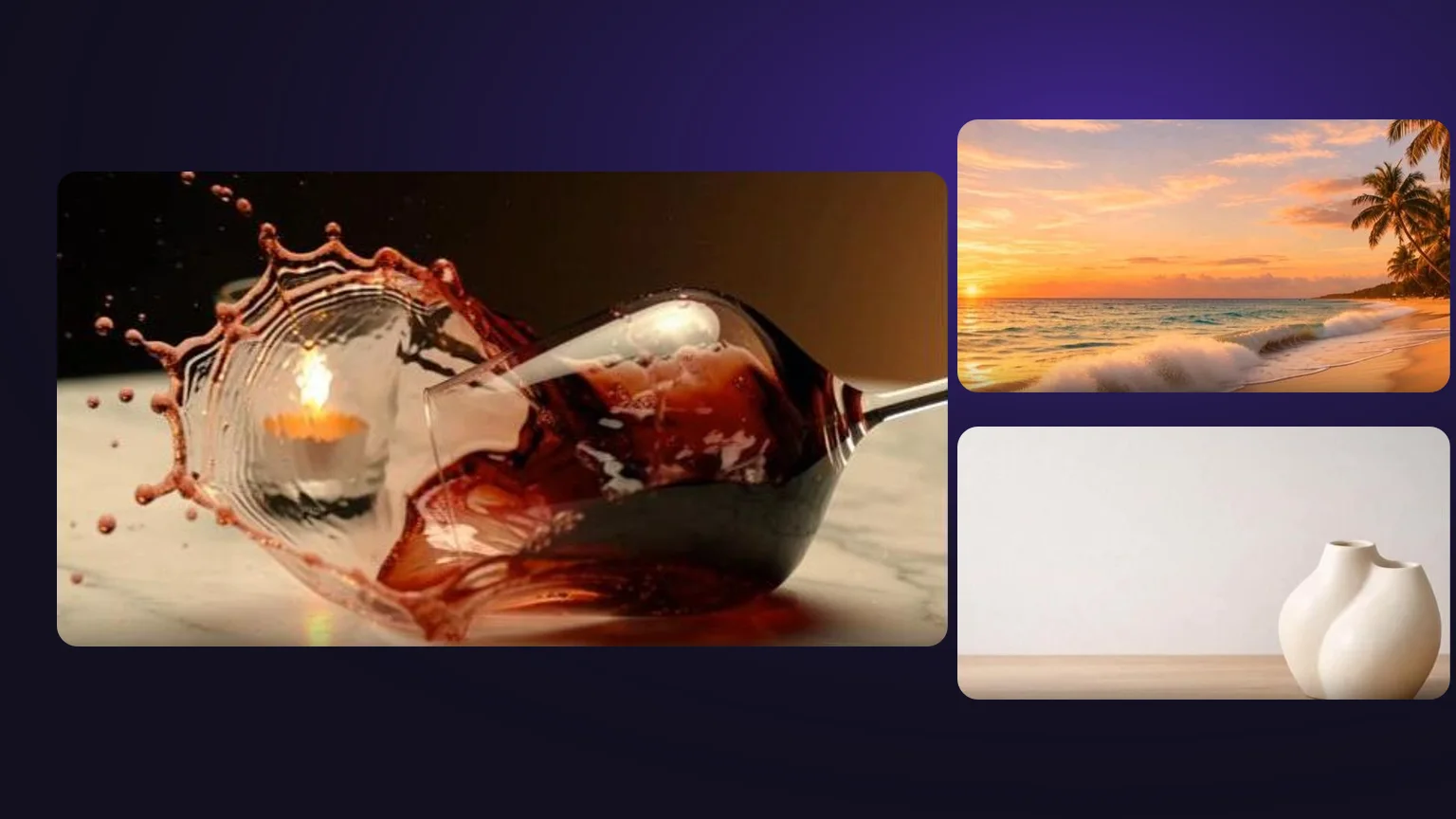
- MiniMax H3 delivered its three clips in 5 seconds and 720p, for 240 credits each, and Wan 2.2, Kling 2.6 and Veo 3.1 Lite passed three more tests: a beach that was true to the starting image, a deformed vase, a convincing spilled wine glass.
- The price is displayed before the click and it has always been respected 240 announced, 240 debited; 20 for Face Swap photo; 364 for 7.57 seconds of talking photo. Default activated audio adds 50% to the price of a clip.
- The download works on the Pro plan : a MP4 H.264 of 1296 x 720, 1.5 to 4.7 MB for 5 seconds, watermark-free visible on our three clips. They're looking down.
- The Face Swap photo is fast and cheap (less than 8 seconds, 20 credits), but the proposed starting models highlight real celebrities.
- Paid plans cost 10.75 to 56 € Annual per month, watermark-free and with commercial use according to the tariff page. A 5-second clip returns to about 0.20 € annual subscription, and 0.43 to 0.54 € with a package of credits.
What's Magic Hour?
Magic Hour is a web application that brings together three families of tools. Video side: image to video, text to video, Face Swap video, talking photo, lab synchronization, editor, video extension and expansion, generator music clips, video translation, watermark removal, UGC ads. Image side: generator, editor, Face Swap photo, head or body exchange, enlargement, detour. Audio: voice, voice cloning, music, noise. The tariff page lists about 40 d tools in total, which the publisher announces in « 100+ tools » on his home page.
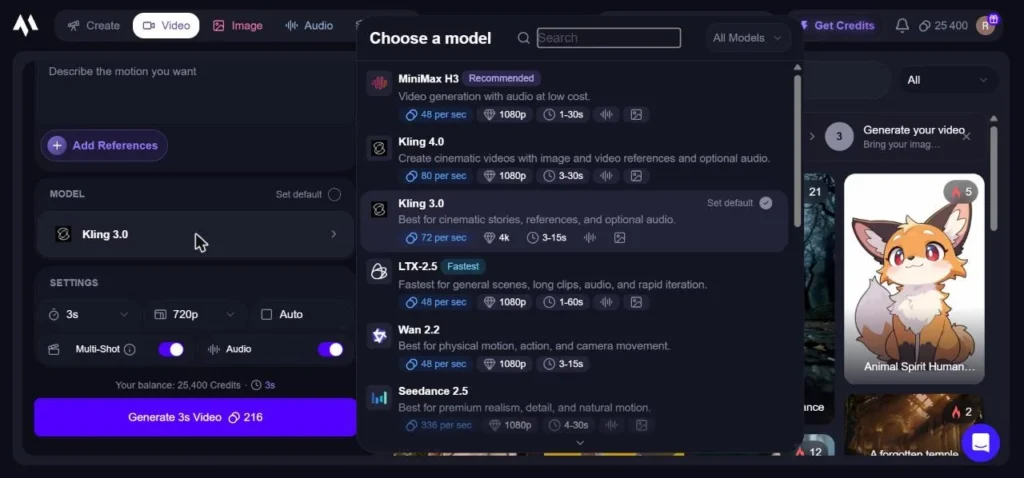
The operation is simple: each tool has its page with a left adjustment panel, a right history, and a button « Generate » which displays the cost in credits. The most useful is the selection of models from image to video: on the day of the test, it proposed MiniMax H3 (recommended), Kling 4.0, Kling 3.0, Kling 2.6, LTX-2.5, Wan 2.2, Seedance 2.5, 2.0 and 2.0 Mini, Veo 3.1 and its Lite version, Google Omni, among others, each with its price per second.
Our test protocol
The account is the one we opened for this test, passed in Pro for free by the publisher. We piloted everything in the browser, with files of our own. For the image to video, we have taken the two examples of our guide Image to Video AI : a beach at sunset and a ceramic vase on a wooden table. Accuracy: the comparison image to video published on our website brother infosdivers is a documentary work, without photo source, so we didn't have any game images to reuse. For the text to video, we took over the delivery of the glass of wine spilled from our Higgsfield test, which allows a rough comparison. For the Face Swap and the talking photo, two portraits royalty-free (licence Pexels) and a French synthesis voice generated on our PC.
Before each generation, we noted the price displayed on the button and then raised the balance after the fact. The clips are 5 seconds in 720p, except for the talking photo (7.57 seconds) and the Veo 3.1 Lite clip (4 seconds, the proposed minimum duration). Faceless clips were downloaded and then recompressed for this page; For the rest, we show only catches of the application. We did not listen to the audio tracks, so we do not judge the sound or the precision of the labial synchronization.
| Trial | Model | Display price | Final flow | Time taken | Result |
|---|---|---|---|---|---|
| Image to video, beach | Kling 3.0 (default) | 360 | 0 (reimbursed) | failure after more than 40% progression | Failed, unknown error |
| Image to video, vase | MiniMax H3 | 240 | 240 | less than one minute | 5 s clip, deformed vase |
| Image to video, beach | MiniMax H3 | 240 | 240 | about a minute and a half | Clip of 5 s faithful |
| Image to video, range (new essay) | Kling 3.0 | 360 | 0 (reimbursed) | less than two minutes | Failed, unknown error |
| Face Swap photo | not specified | 20 | 20 | less than 8 seconds | Image delivered |
| Spoken photo, 7.57 s, expressive mode | LTX-2.5 | 364 | 364 | about 40 seconds | Clip 8 s |
| Text to video, glass of wine | Kling 3.0 | 360 | 0 (reimbursed) | less than two minutes | Failed, unknown error |
| Text to video, glass of wine | MiniMax H3 | 240 | 240 | about 2 min 30 | Clip 5.17 s, 1296 x 720 |
| Image to video, beach (end of evening) | Wan 2.2 | 240 | 240 | Not timed | Clip of 5 s, 16 images per second, without sound |
| Image to video, beach (end of evening) | Kling 2.6 | 180 | 180 | Not timed | Five s clip, without sound |
| Image to video, vase (end of evening) | Veo 3.1 Lite | 288 | 288 | Not timed | 4 s clip with sound, vase preserved |
The balance of the first series rose from 25,400 to 24,296 credits. The 1,104 credits consumed break down exactly into 240 + 240 + 20 + 364 + 240. The three late evening trials (240 + 180 + 288 = 708) reduced the balance to 23,588, or 1,812 credits consumed in total. The three Kling failures (3 x 360 = 1,080 credits) were rendered each time, without any action on our part.
Image to video: default settings and model grid
When you open the image to video, the selected model is Kling 3.0, duration 3 seconds, resolution 720p, with « Multi-Shot » and « Audio » activated. The button then announces 216 credits for 3 seconds, that is 72 credits per second. The list of Kling 3.0 resolutions shows 48 credits per second in 720p, 72 in 1080p and 240 in 4K. The difference comes from audio: in 5 seconds and 720p, the button increases from 360 credits with the sound to 240 without, or 24 credits per second more. This 50% supplement is not reported on the button: you should look at the switch.
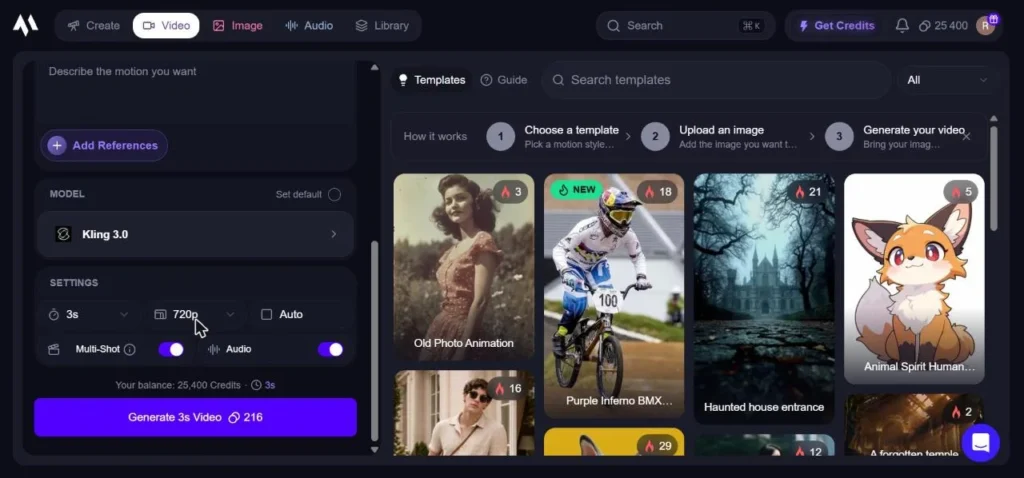
The model selector is the real asset of the platform. Price per second recorded on test day: MiniMax H3 48 credits (1-30 seconds, 1080p), Kling 4.0 80 (3-30 seconds, 1080p), Kling 3.0 72 (3-15 seconds, up to 4K), LTX-2.5 48 (1-60 seconds), Wan 2.2 48, Seedance 2.5 336, Seedance 2.0 216, Seedance 2.0 Mini 120, Veo 3.1 120, Veo 3.1 Lite 72, Kling 2.6 36. The differences are enormous: with equal duration, Seedance 2.5 costs seven times MiniMax H3.
Kling 3.0: three out of three failures
Our first test was started with default settings: the range, Kling 3.0, 5 seconds, 720p, audio enabled, 360 credits. The application immediately debited the balance (25,400 then 25,040), placed the task in the « Pro priority tail » and posted an increase: 24%, then 41% with four minutes of waiting announced. Then a red cross: « Your video failed to render. An unknown error occupied. Please try again or reach out to our support. » The message states that 360 credits have been repaid, and the balance has actually returned to 25,400.
We started again with the same picture and the same statement: same failure, same refund. Then, to exclude an image-to-video problem, a text-to-video essay with Kling 3.0: third failure. Three launches, three failures, all on Kling 3.0; the four generations launched with MiniMax H3 and LTX-2.5 passed. We cannot say whether it was a one-time incident of November 1 or a recurring defect: three tests do not prove anything about the duration. We only find that the default selected model did not work that day, and that the error message does not give any track.
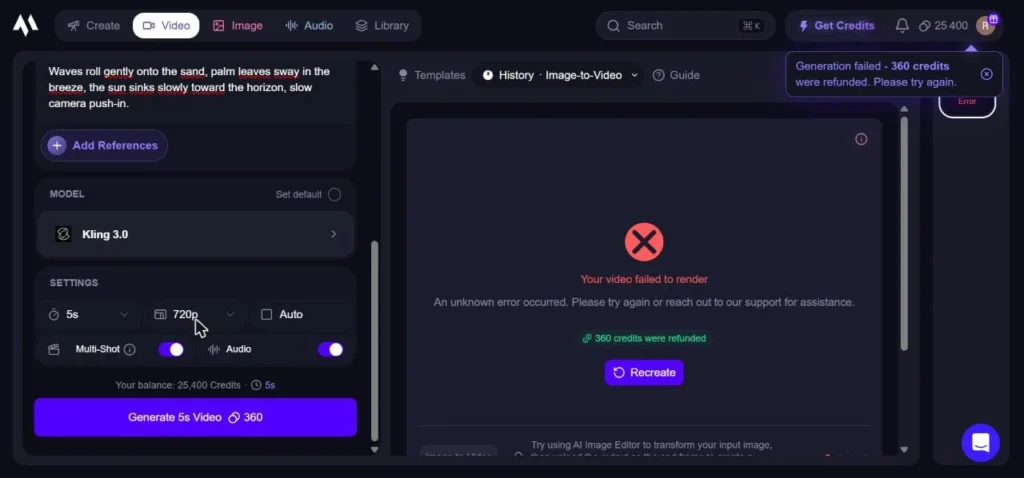
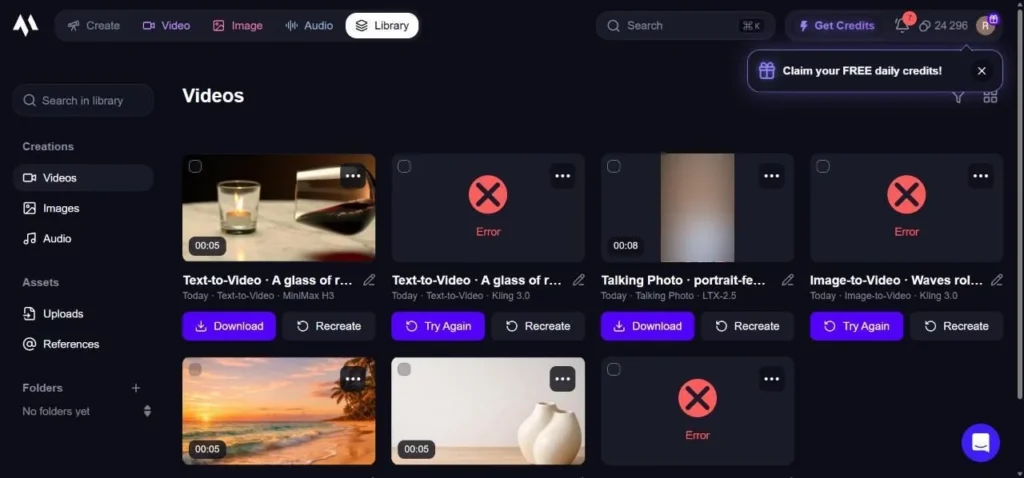
The positive point is reimbursement: it is automatic, immediate and without question. The negative point is that, for once when Kling is the default model and the most cited on the page, it is useless if the rendering crashes. Our review on Kling AI remains useful for knowing the model on its original platform.
MiniMax H3 in image to video: the faithful beach, the deformed vase
We went to MiniMax H3, model « recommended » of the list, to 48 credits the second, that is 240 credits for 5 seconds in 720p with audio. The line announced about 20 seconds of waiting, and the vase clip was ready in less than a minute.
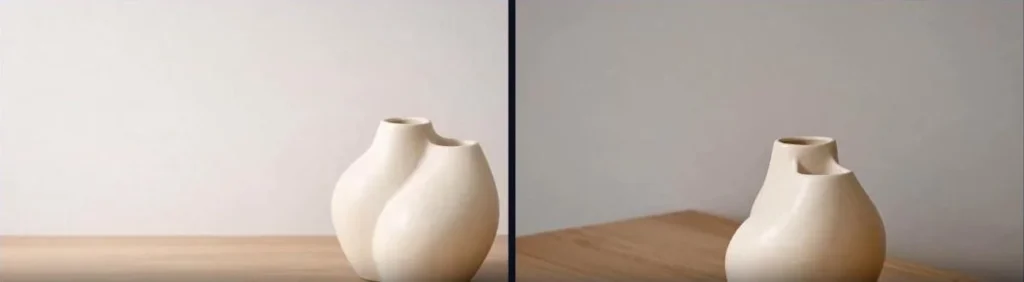
Vase: the shape does not hold
Consignee: « The ceramic vase slowly rotates on the wooden table, soft light shifts across its surface, subtle camera orbit around the vase. » The clip is 5 seconds long, watermark-free visible in the preview. But the result betrays the object: on the starting image, the vase has two necks joined; At 5 seconds, he has only one, with a notch, and the camera changed its point of view. For a product visual, it is the defect that counts: an object that changes shape is unusable in e-commerce, even if the light and grain of the wood remain credible.
The beach: the best result of the session
Consignee: « Waves roll nicely ono the sand, palm leaves sway in the breakeze, the sun songs slowly towards the horizon, slow camera push-in. » Here the clip follows the starting image. Waves arrive more ecumic at 4 seconds, palm trees move, orange light remains consistent. Two reserves: the sun, which was to come down, is on the left edge of the frame at 5 seconds because the camera slipped, and no coarse artifact is visible on the images we looked at. For a social network atmosphere, it is exploitable as it is.

Our guide to animate a photo with AI gives the method for writing the movement instructions; With Magic Hour, only one main movement per set remains the right rule.
Text to video: glass of wine, in 2 minutes 30
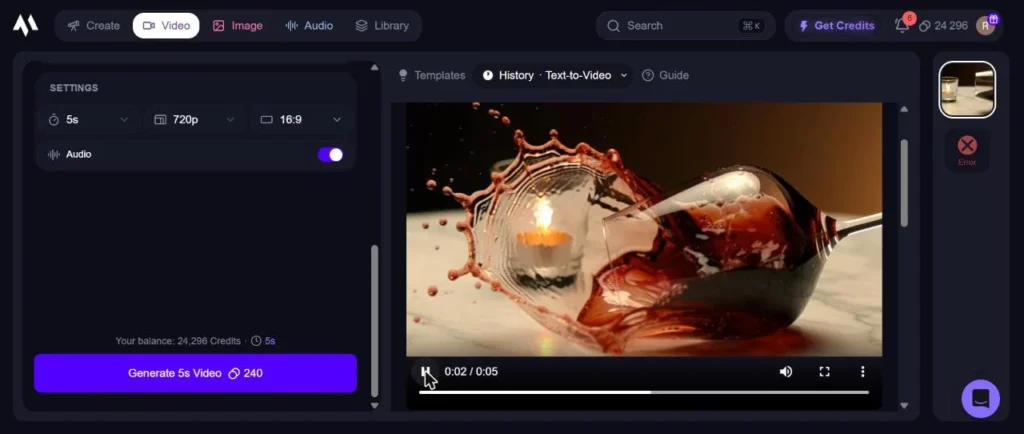
The text to video opens with a default format of 9:16 (vertical), which you have to change to 16:9 if you want the landscape. We took word for word the wine glass delivery from our Higgsfield test, in 16:9, 5 seconds, 720p, with MiniMax H3 as Kling 3.0 failed. The clip arrived after about 2 minutes 30 and measures 1296 x 720 pixels by 5.17 seconds.
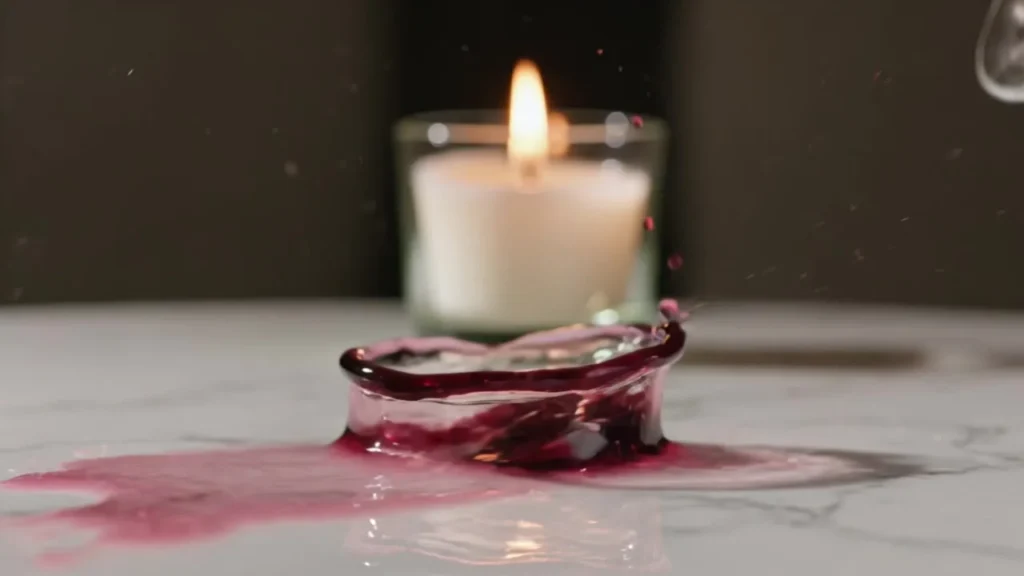
The result is the best surprise of the test. At 2 seconds, a wine splash in the shape of a crown is released in front of the candle flame, which remains clear; In the end, the wine spreads on marble. Two defects: the glass is a glass on foot while the set-up only said « a glass of red wine », and it is already inclined to the first image, so we do not see the tilt from the vertical. On the wine crown, the rendering compares with what we had obtained with Kling 3.0 on Higgsfield, without we being able to compare the cost, the credit units being different.
Three more models: Wan 2.2, Kling 2.6 and Veo 3.1 Lite
After the failures of Kling 3.0, we re-launched the same images with three other models on the list, on November 1, 2026 at the end of the evening, with the same instructions as for MiniMax H3. One draw per model: these are trends, not rankings. The three clips were ready when we reopened the library a few minutes after the launches; We didn't time them.
Wan 2.2 and Kling 2.6 on the beach: the picture frame holds
Wan 2.2 (240 credits for 5 seconds in 720p, 48 per second) and Kling 2.6 (180 credits, 36 per second) kept the frame of the photo: the sun remains on the left edge of the horizon, palm trees on the right, and the waves move forward. This is what MiniMax H3 had not done, with its frame sliding to the left. Both files do not have an audio track: the form did not offer an audio option for these models. Wan 2.2 comes out at 16 frames per second, Kling 2.6 to 24; The Kling file weighed 11.9 MB before recompression, compared to 3.6 MB for Wan.
Veo 3.1 Lite on the vase: both necks remain
In the picture of the vase, Veo 3.1 Lite kept the two necks on the images we looked at, where MiniMax H3 had deleted one. The clip lasts 4 seconds, the minimum duration of the model in the form, and costs 288 credits with the sound enabled (72 per second). The camera barely moves: the set-up required a light turn around the vase, and we don't see any. The file contains a generated audio track that we did not listen to. In the selector, Veo 3.1 Lite appeared at 48 credits the second in this second survey, against 72 in our first list; we have not checked what explains the deviation (its, resolution).
Face Swap photo: 20 credits, less than 8 seconds
L tool of the Face Swap photo offers three modes (face, head, body) and two deposit areas: the photo to change and the face to use. We put the portrait of a woman as a photo to change and that of a man as a face. The button displayed 20 credits (10 before the photos were filed), and the image arrived in less than eight seconds. The result keeps the hairstyle, shirt collar and background of the original photo, with the face of the other portrait. We still see a difference of complexion between face and neck. No watermarks appear on our Pro account preview.
One point of attention: the starting models proposed by the application highlight real people. On 1 November, we saw a editing appointed « Ariana Grande Edit » in the Face Swap video, and examples named after Mark Zuckerberg, Drake or Florence Pugh in the talking photo. Using someone's face without his consent can be illegal in France: see our guide on the legality of deepfakes. To compare with other tools of the Face Swap, our comparison of the best Face Swap remains the reference; it dates from May 2026 and its indications on the credits offered by Magic Hour are to be read again in light of this test.
Spoken photo: 364 credits for 7.57 seconds
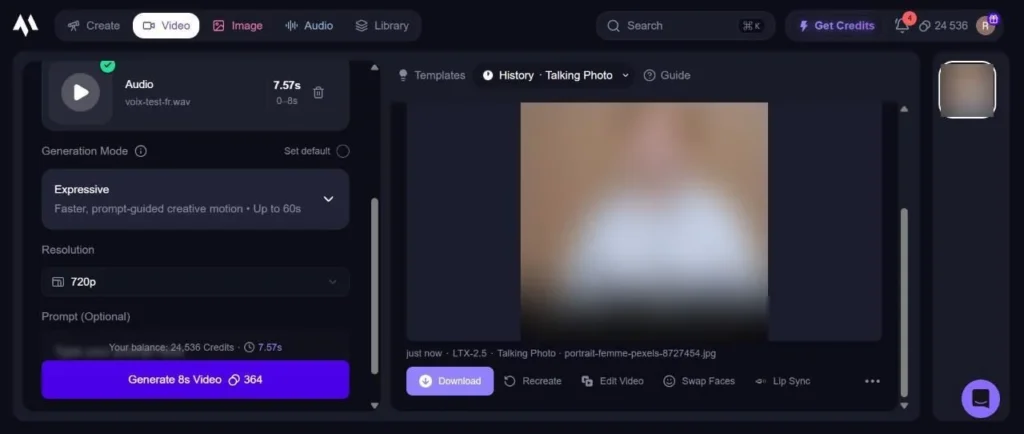
The talking photo requires an image and an audio file. We sent a portrait and a WAV file of 7.57 seconds, generated with the French voice of Windows. Fashion « Expressive » (up to 60 seconds, faster) was selected by default; mode « Realistic » promises the best labial synchronization and up to 300 seconds. The prices follow the resolution: 24 credits the second in 480p, 48 in 720p, 72 in 1080p. We kept 720p and Expressive: 364 credits, i.e. 48 x 7.57.
The rendering took about 40 seconds (33 announced) and lasts 7 seconds on screen, with the LTX-2.5 model displayed under the video. On the images we looked at, the mouth opens at 4 seconds, a smile appears at the end of the clip, the head and shoulders move a little. We cannot judge alignment with sound. Our guide for make a photo speak for free details the other options. Under the video, the app offers Download, Recreate, Edit Video, Swap Faces and Lip Sync, which allow you to link the tools.
Credits and prices: from 10.75 to 56 € per month
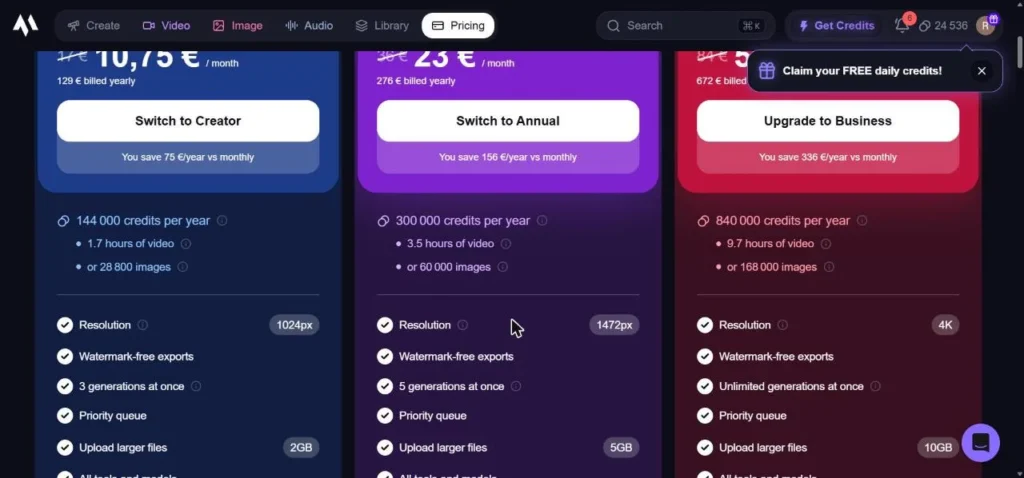
The official tariff page, consulted on November 1, 2026, posted three subscriptions. The prices below are those of the annual invoice, with the monthly price barred in brackets.
| Plan | Price per month (annual) | Appropriations per year | Video hours announced | Simultaneous | Upload limit |
|---|---|---|---|---|---|
| Creator | 10.75 € (17) € monthly), 129 € per year | 144 000 | 1.7 h | 3 | 2 GB |
| Pro | 23 € (36 € monthly), 276 € per year | 300 000 | 3.5 h | 5 | 5 GB |
| Business | 56 € (84 € monthly), 672 € per year | 840 000 | 9.7 h | unlimited | 10 GB |
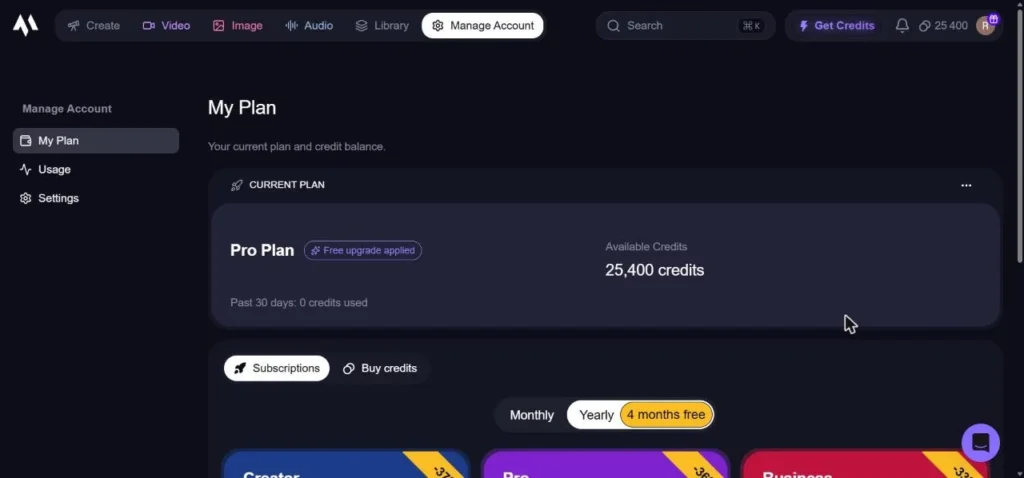
All plans include exports watermark-free, commercial use, access to all tools and models, a priority queue and API. The announced resolution ranges from 1024 px (Creator) to 1472 px (Pro) and 4K (Business). The credit packages, with no expiry date after the page, range from 4,000 credits to 8.94 € 64 000 appropriations at 114.43 €. Our Pro account had 25,400 credits, which corresponds to about one-twelfth of the 300,000 annuals: the page does not say how the credits are paid, we can only assume.
To make this concrete, here is a calculation of our share (credits divided by the price paid, excluding promotions) for a 5-second clip to 240 credits like those of MiniMax H3.
| Source of appropriations | Price of credit | Clip of 5 s (240 credits) | Clip Kling 3.0 with sound (360) |
|---|---|---|---|
| Creator subscription, annual | approximately 0.0009 € | about 0.22 € | approximately 0.32 € |
| Annual subscription | approximately 0.0009 € | about 0.22 € | approximately 0.33 € |
| Business subscription, annual | approximately 0.0008 € | approximately 0.19 € | about 0.29 € |
| Package of 4 000 credits (8.94 €) | approximately 0.0022 € | about 0.54 € | approximately 0.80 € |
| Pack of 64 000 credits (114.43 €) | approximately 0.0018 € | approximately 0.43 € | about 0.64 € |
The calculation shows that the annual subscription divides the price of the clip by about two compared to the packs, and that the expensive models (Seedance 2.5 to 336 appropriations the second) quickly exit the budget: 5 seconds cost 1,680 appropriations. To limit the bill, pass audio on « Off » when you don't need one third of the price.
Watermark, rights and what we could not verify
On our Pro account, there were no watermarks, and the tariff page specifies that exports watermark-free and commercial use are included in each subscription, as in the credit packages. We did not test a free account: the banner « Claims your FREE daily credits » and the button « Claims 100 daily credits » menu suggests that a free plan exists, with daily credits, but we cannot say what limits, watermark or resolution it imposes.
What this test does not cover: the Kling 4.0 models, Seedance and Veo 3.1 (excluding Lite version), which are proposed but which we have not launched, only one version of Wan (2.2), the Face Swap video, lab synchronization, video editor, translation, audio and generator images. We chose to save credits offered rather than multiply tests without noting them. On the other hand, we downloaded the three faceless clips (plage, vase, glass of wine) from the library on November 1, 2026: the Download button provided a direct MP4 file, in H.264, from 1296 x 720 pixels to 24 images per second, 5.17 seconds, with a stereo AAC audio track, for 1.5 MB (vase), 4.0 MB (wine glass) and 4.7 MB (plage). We did not spot any watermarks on the full-sized images. We then recompressed the clips for this page, hence the lighter videos you read here. We did not download the talking photo or the Face Swap whose faces are not published.
What alternatives to Magic Hour?
Magic Hour is especially worth its choice of models and its tools Annexes. As needed, other solutions in our selection are more suitable. For a complete panorama, our comparison of the AI video generators free covers trial offers.
| Tool | To choose if | Our review detailed |
|---|---|---|
| Higgsfield | You want several models (Kling, Seedance, Veo, Wan) behind a subscription and a price displayed before each generation | Higgsfield review |
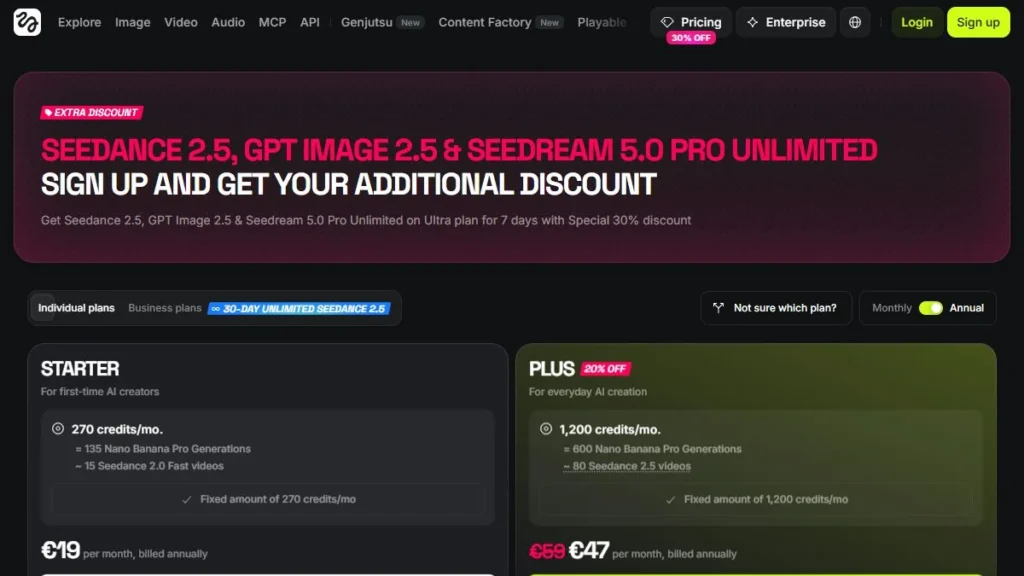
| Kling AI | You want the Kling model directly from its publisher | Kling AI review |
| Hailuo AI | You want the MiniMax model at its publisher | Hailuo AI review |
| GenFlick | You want a movie or advertising in several planes with coherent characters | GenFlick review |
| PixVerse | Looking for ready-to-use viral effects | PixVerse AI review |
Higgsfield: the same principle, with a price announced before each clip
Higgsfield also brings together several third-party models behind a credit counter. During our October 27 test, a 5 seconds in 720p Kling 3.0 clip cost 7.5 credits on the button, and the debit had always been equal to the price displayed. The units are not Magic Hour's, so the comparison is about the method, not the price.
Kling AI: the model that failed at Magic Hour
If it's Kling you're targeting, going through its original platform avoids an intermediary. To judge the quality, here is the wine glass of the same order obtained with Kling 3.0 during our Higgsfield test: the splash crown is also well restored.
Hailuo AI: MiniMax at its publisher
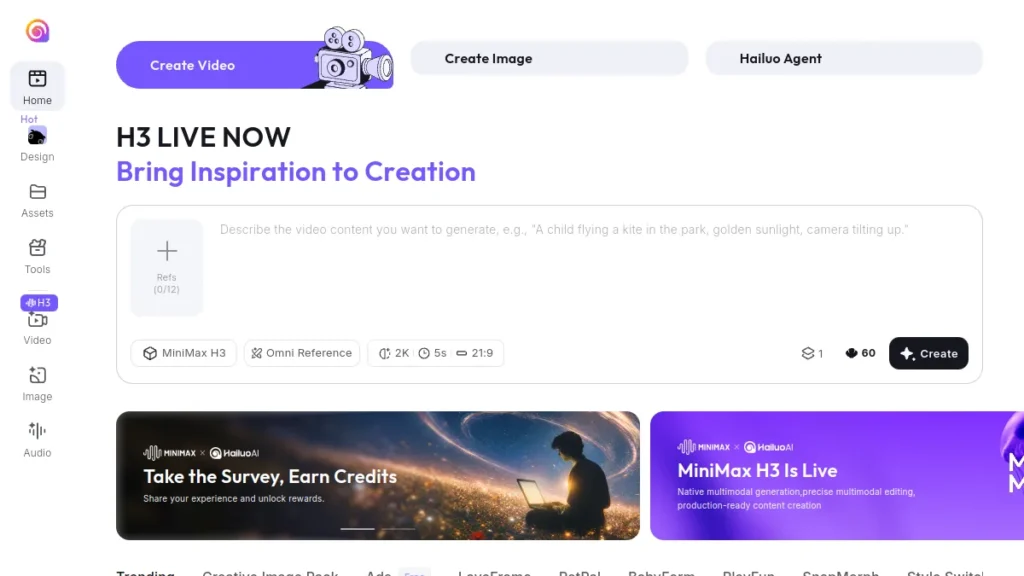
MiniMax H3 is the model that made our test work. Hailuo AI is the platform of its editor: its interface puts a quick field in the center of the screen.
GenFlick: Movies and commercials in multiple shots
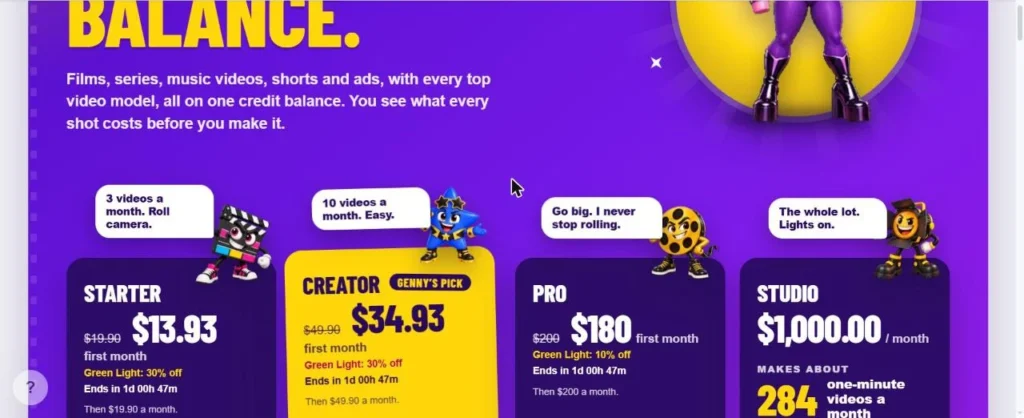
GenFlick starts with a script and a storyboard, with coherent characters, where Magic Hour works clip by clip. Our October 23 test produced a 30-second film.
PixVerse: viral effects
PixVerse is to watch if you are looking primarily for ready-to-use effects for networks. Our review details its daily credit system.
For an advertisement produced from a card, our dAdsTurbo Shows another approach. And for face exchange, the page of a direct competitor is visible in our comparison of the Face Swap.

For whom Magic Hour makes sense, and for whom not
It makes sense for a creator who wants a single subscription giving access to many models, who changes model according to the instructions and who knows the prices per second. The automatic refund of chess is a real comfort. It also makes sense to anyone who wants tools Annexes under hand: Face Swap, talking photo, lab synchronization, video extension.
It has less meaning for who relies on the default model without looking (Kling 3.0 failed every time that day), for who wants a perfectly faithful product rendering (the vase has changed shape) or for who needs a fine sound control without extra cost: default activated audio adds half the price. And for real-faced use, the legal framework is entirely yours.
Verdict: a box to tools generous, to use with the right model
🎯 Verdict
Magic Hour keeps its promise on the essentials: we choose a model, the price is displayed before the click, it is respected to the credit close, and the credits of failed renders come back alone. On our tests, MiniMax H3 gave good clips of 5 seconds for about 0.22 € in annual subscription, with a faithful beach and a glass of wine convincing, but also a deformed vase. Kling 3.0, the default model, failed three times out of three on the day of the test, without explanation. To test with the free plan or a small pack before subscribing, keeping MiniMax H3 as the starting model and cutting audio when it is not serving. Note: This test covers ten single-day launches; it does not replace prolonged use.
FAQ: Your questions about Magic Hour
Is Magic Hour free?
We tested it with the Pro plan offered by the publisher. The app also offers daily free credits (one button) « Claims 100 daily credits » is visible in the account menu), but we haven't tested a free account: we can't tell which limits it imposes. Paid plans range from 10.75 to 56 € per month in annual billing after the 1 November 2026 tariff page.
How much does a video with Magic Hour cost?
On our tests, 240 credits for 5 seconds in 720p with MiniMax H3, which represents about 0.22 € with an annual Pro subscription and 0.43 to 0.54 € with a package of credits. With Kling 3.0 and audio enabled, the same clip is displayed at 360 credits. The Face Swap Photo costs 20 credits and the talking photo 48 credits per second in 720p.
Why did Kling 3.0 fail?
We don't know. Three launches with Kling 3.0 (two in image to video, one in text to video) returned « An unknown error occupied » 1 November 2026, with automatic reimbursement of 360 credits. The MiniMax H3 and LTX-2.5 generations launched during the same session were successful.
Are credits reimbursed in case of failure?
Yes, from what we've found: every time the application failed, the 360 credits were automatically returned and the balance was returned to its previous value.
Do Magic Hour videos have watermarks?
Not on our Pro account, based on the previews we looked at. The tariff page shows exports watermark-free and commercial use in each subscription and in credit packages. We downloaded three MP4 clips: no watermark visible on full-size images. We didn't test the free plan.
Which model to choose in Magic Hour?
To test at low cost, MiniMax H3 (48 credits per second) was the model recommended by the application and the only one to have worked in text to video during our test; In video, Wan 2.2, Kling 2.6 and Veo 3.1 Lite also ended at the end of the evening. Models Seedance 2.5 (336 credits per second) and Veo 3.1 (120) are much more expensive and we have not tried them.
Can we do some Face Swap Magic Hour?
Yes: Face Swap photo took less than 8 seconds and 20 credits on our trial, with three modes (face, head, body). Using a person's face without his consent can be illegal in France.
Does Magic Hour have an affiliate program?
Not so far, according to our discussions with the publisher: he said he would warn us when there would be one. No link of this review is a partner link.