Wan, it's the video model family from Alibaba, and it's probably the most misunderstood name in the sector. It is presented in turn as « the Kling open source », as a generator free, or as a simple Chinese model more. The three are half true. Wan 2.1 and 2.2 are actually open source and turn on your PC; Wan 2.5, 2.6, 2.7 then Wan 3.0, released on August 24, 2026, are not, and use online. If you are looking « Wan 2.5 », you mostly come across dealers who charge it at the second. We put it straight: what each version does, how to access it for free, and when it is better to prefer Kling or Seedance.
📌 Essentials
- Wan AI is developed by Alibaba (Toggyi laboratory). The most recent version is Wan 3.0 (24 August 2026): up to 30 seconds in 1080p.
- Open source: Only the 2.1 and 2.2 generations have published weights (Apache 2.0 licence). Wan 2.5 and the following are closed, accessible online or by API.
- Free: yes locally with Wan 2.2 (if you have the graphics card), and via daily credits on the official platform create.wan.video.
- Wan 2.5 (end of September 2025) brought native sound and 10-second clips; it remains highly proposed by third-party platforms.
- Facing Kling and Seedance, Wan is distinguished by its open source ecosystem and long clips; Kling remains simpler to start in French, Seedance stronger on synchronized audio.
Contents: What Wan AI is • Versions • Wan 2.5 • Free and open source? • Use Wan Online • Use Wan locally • Our review • Wan vs Kling vs. Seedance • FAQ
What is Wan AI?
Wan (sometimes written Wanx, his former name, or Tongyi Wanxiang in China) is a family of video and image generation models designed by Alibaba. It covers the text to video, the image to video, the video from the first and last image, the animation of characters and, since the last versions, the generation of sound at the same time as the image.
Three things must be distinguished when talking about « Wan AI » :
- Open models (Wan 2.1, Wan 2.2 and their variants Animate, S2V): downloadable, available locally or in ComfyUI, under Apache 2.0 license.
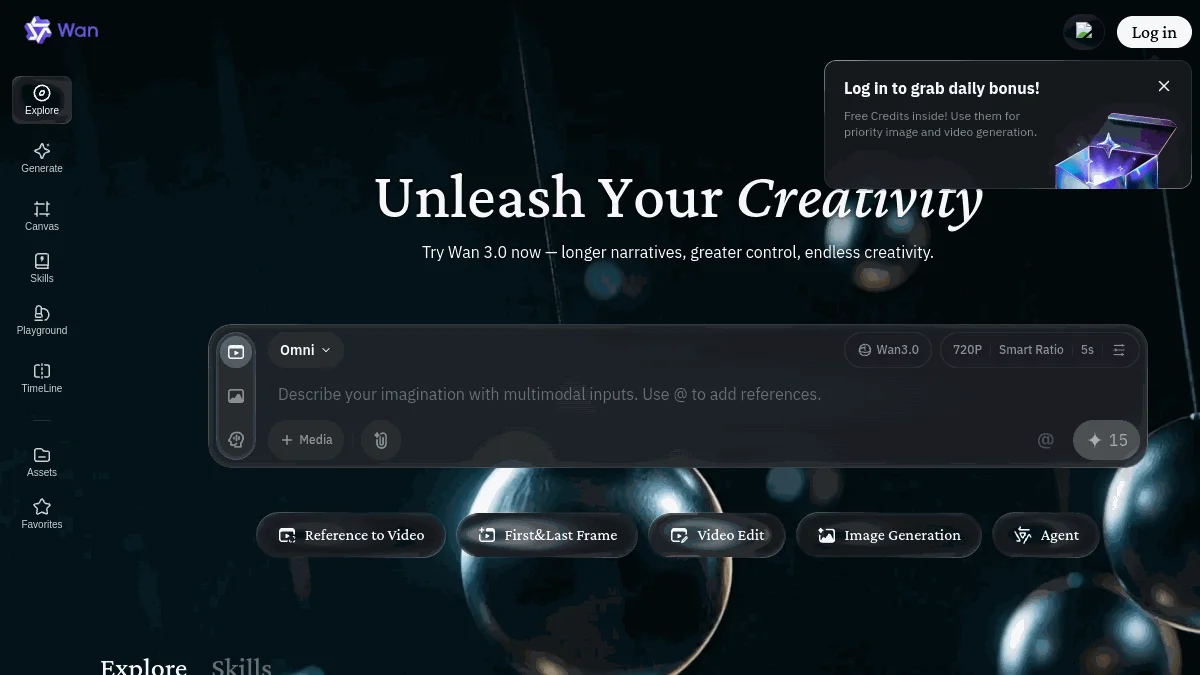
- The official platform create.wan.video: a web interface in which it generates with the latest models, with free credits and paid formulas.
- API d Many domains such as wan25.net or freewanvideo have no official connection with Alibaba.
Wan 2.1, 2.2, 2.5, 2.6, 2.7, 3.0: what differences?
Alibaba emerged six generations in 18 months, and the pace explains much of the confusion. Here is the table that we would have liked to find at the beginning, drawn up after the announcements of Alibaba and the official deposits on October 11, 2026.
| Version | Check out | Open weights | Maximum duration | What she brings |
|---|---|---|---|---|
| Wan 2.1 | February 2025 | Yes (Apache 2.0) | Approximately 5 s | First high-level open source video model, light 1.3B version for modest PC |
| Wan 2.2 | 28 July 2025 | Yes (Apache 2.0) | Approximately 5 s | Expert Architecture (MoE), model 5B in 720p at 24 i/s, then Animate and S2V |
| Wan 2.5 | End of September 2025 (preview) | No | 10 s | Native sound (voice, effects, music), 1080 p |
| Wan 2.6 | 16 December 2025 | No | 15 s | Several stories, reference video (play with your voice) |
| Wan 2.7 | Spring 2026 | No | 15 s | Mode « reflection » to better follow the prompt, more precise control |
| Wan 3.0 | 24 August 2026 | No | 30 s | Twice longer clips, entry documents and web pages, 480p to 1080 p |
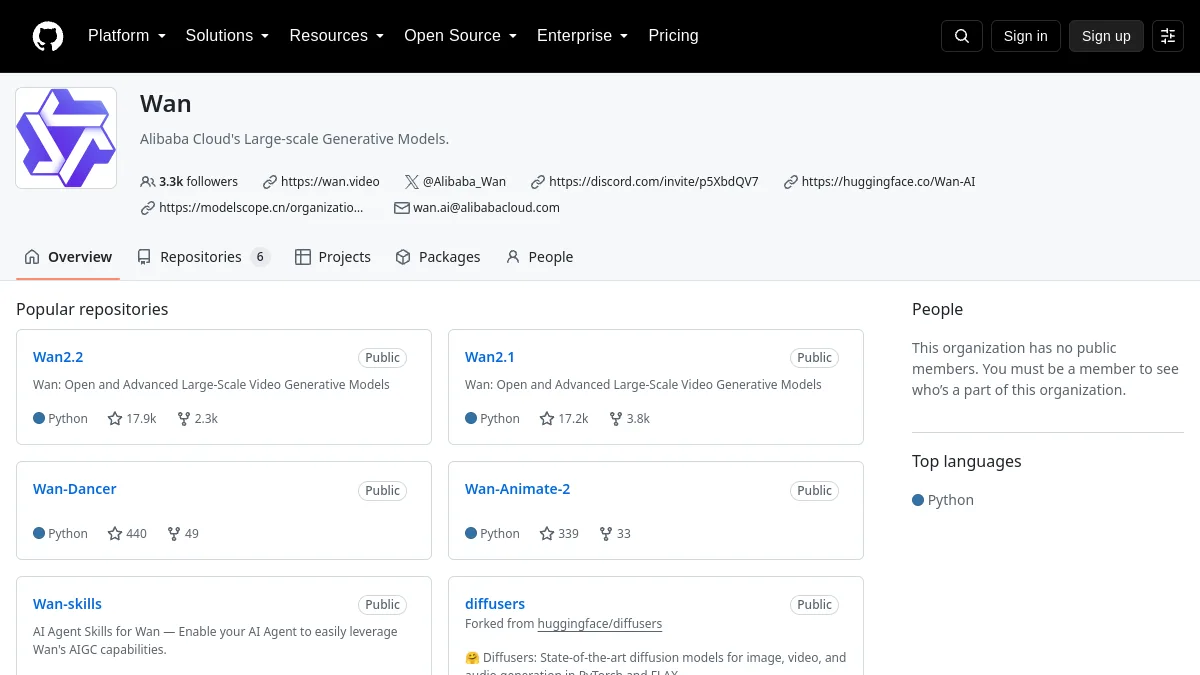
Two remarks. First, several sites claim that Wan 2.5 or 2.6 « are open source » On October 11, 2026, neither the GitHub Wan-Video nor the Hugging Face page of Alibaba publish their weights. The only recent open additions are variants of Wan 2.2 (Wan2.2-Animate-2 and Wan-Dancer, published in July 2026). Then the platform and the API change quickly: always check which version you are actually using, many resellers still display « Wan 2.5 » by habit.
What is Wan 2.5?
Wan 2.5 is the version presented by Alibaba at the end of September 2025, « preview ». It was she who brought Wan into the court of Veo 3 and Sora 2: for the first time, the model generated the sound at the same time as the image. Dialogues with several voices, sounds, atmosphere, music, all synchronized in the same file. It also doubled the duration (10 seconds instead of 5 seconds) and mounted the definition until 1080p.
Why is everybody talking about it another year later? Because Wan 2.5 has arrived on a multitude of third-party platforms, often cheaper than competing models, and these sites have produced many pages in his name. This is no longer the best version of Wan, but it is often the one you will find in an aggregator. If you have the choice on the official platform, Wan 2.6 or 2.7 do better for close use, and Wan 3.0 if you need more than 15 seconds of one holding.
Is Wan AI free and open source?
Both, depending on the version, and that's what makes it interesting.
Free and unlimited: Wan 2.2 in local
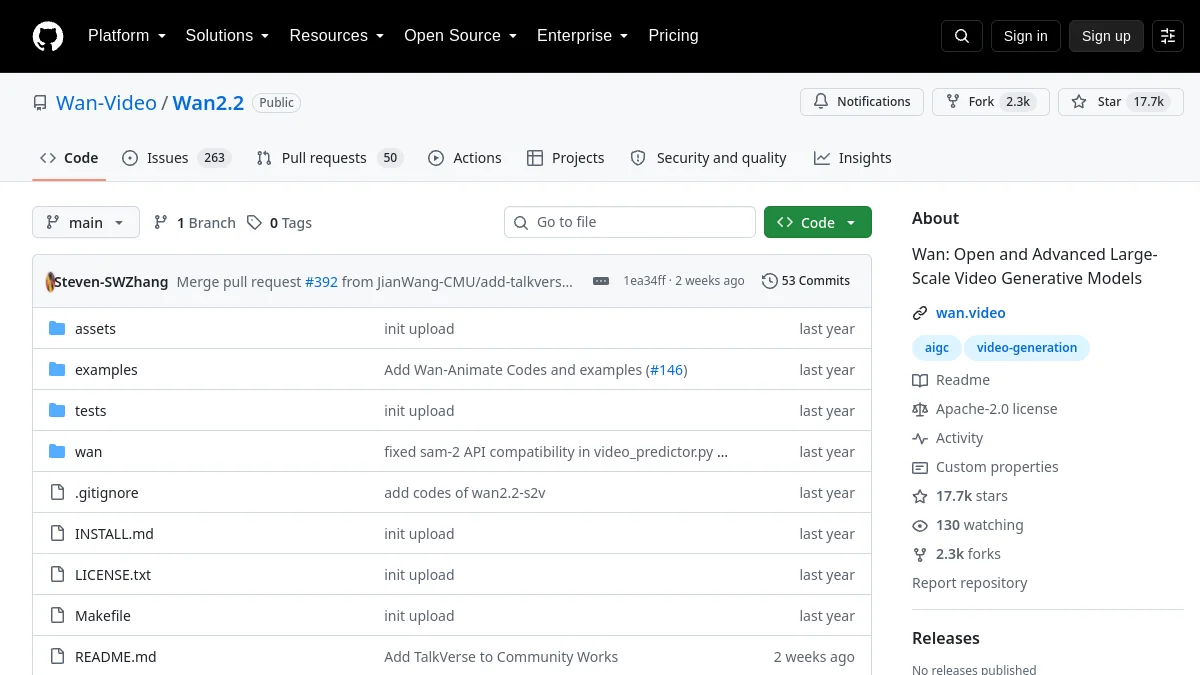
The weights of Wan 2.2 are published under Apache 2.0 license on the official GitHub deposit and on the page Hugging Face of Wan-AI. This license allows commercial use. You pay nothing but electricity, without quota or watermark, and nothing leaves your machine. The price to pay is material, we go back to it lower.
Free with credits: the official platform
On create.wan.video, a free account receives a daily credit bonus by logging in, usable to generate images and videos with recent models, Wan 3.0 included. On October 11, 2026, the interface displays 15 credits for a video of 5 seconds in 720p in default mode. Alibaba does not clearly publish the amount of the daily bonus or the grid of its formulas paid in euros, and the figures circulating on the comparators contradict each other: we prefer not to give you a price that we cannot verify. Simply remember that there are monthly formulas that increase credit, priority queue and exit quality.
Paying at second: API
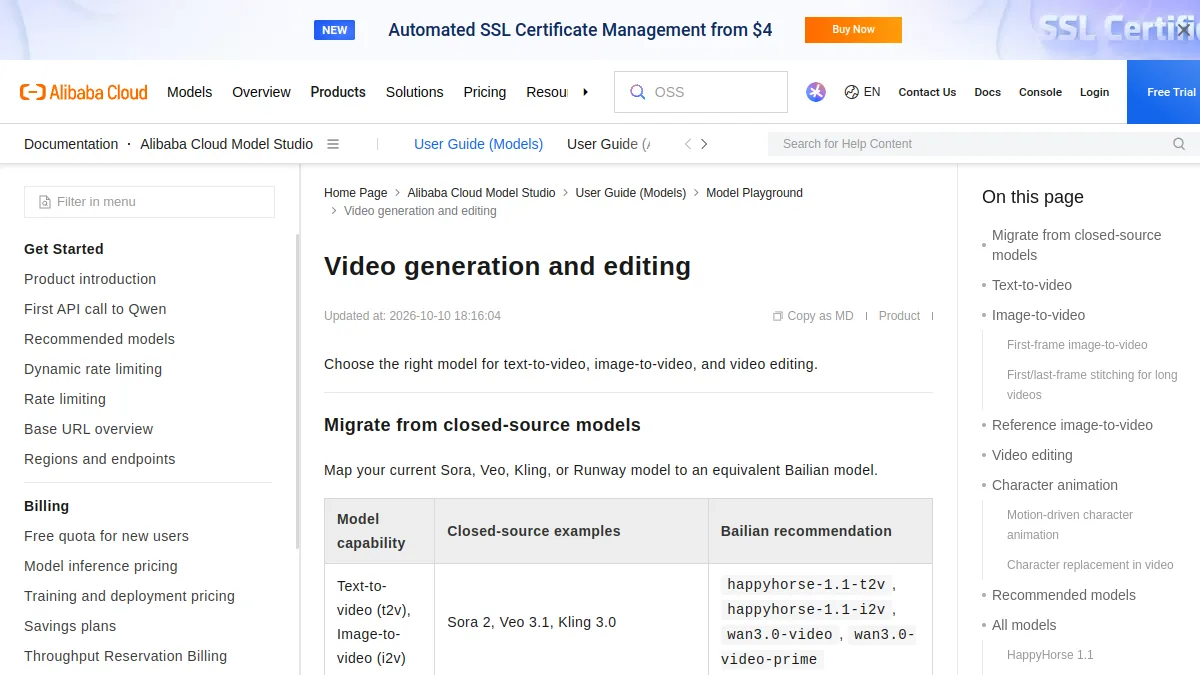
For developers, Wan 3.0 is charged to the second video produced on Alibaba Cloud Model Studio. At the launch, the specialized press noted 0.05 $ per second in 480p, 0.10 $ 720p and 0.20 $ in 1080p, 12 $ the minute in full definition. The official template page gives rates by region in yuan, excluding promotions.
How to use Wan 2.5 or Wan 3.0 online?
The simplest is the official platform. The approach:
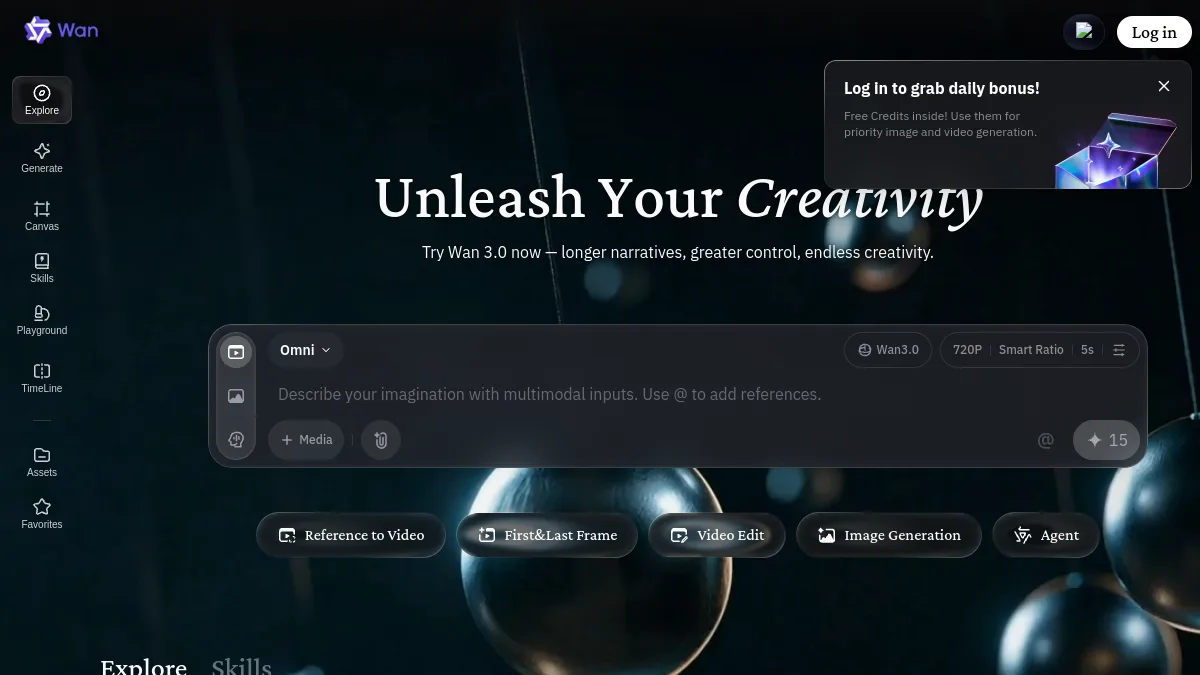
- Create an account on create.wan.video (connection Google and get the daily bonus.
- Choose the mode: « Omni » for text to video, « First&Last Frame » to animate between two images, « Reference to Video » to reuse a character.
- Select Model (Wan 3.0 by default), definition, format and duration. The longer and clearer it is, the more credit it costs.
- Write the prompt in English preferably: the model includes French, but generally more predictable results are obtained in English, with a description of the subject, action, framing and light.
- Run and wait: free of charge, the queue can take several minutes in Asian rush hours.
Third-party platforms (fal, OpenArt, Pippit, etc.) are convenient if you already have a subscription, or if you want to compare multiple models in the same place. Be careful with the sites that bear the name of the model in their domain: they have no connection with Alibaba, sell the API with a margin, and their conditions on your data are sometimes blurred. If you are looking for a generator free, our comparison of the AI video generators free lists the actual quotas of each.
How to use Wan 2.2 locally?
That's where Wan didn't really match Kling's or Seedance, which remain closed. Two ways:
- ComfyUI, the most used node interface for the local generation, has been incorporating Wan 2.2 since the day of its release. You load a ready-to-use workflow model, drop the template files into the right folders, and generate. This is the recommended method.
- Official scripts in Python, since GitHub repository: more flexible, but reserved for those who are comfortable with the command line and Python environments.
The hard point is the graphics card. According to the official documentation, the TI2V-5B compact model (text or image to video, 720p to 24 images per second) requires at least 24GB of video memory, with an RTX 4090 cited as an example. Large A14B models are announced for 80 GB on a single map, which reserves them to servers. The community publishes compressed (quantified) versions and unloading options that allow to descend lower, at the cost of speed and sometimes a little bit of quality. With a map of 8 to 12 GB, target Wan 2.1 in version 1.3B to learn.
💡 Tip: If you don't have the machine, renting a GPU per hour from a cloud host often costs less than a subscription for a one-time project, and you keep the advantage of the open model: no moderation imposed by a platform, no watermark, and your files stay at home.
Our review on Wan AI: strengths and limitations
What we like most about Wan is freedom of choice. No other player of this level lets the creator decide between the free locale, the web with credits and the API at the second. Wan 2.2 in local remains a reference for those who want to learn the video generation without a meter running, and it is the basis of many tools and community extensions (LoRA style, character animation, movement control).
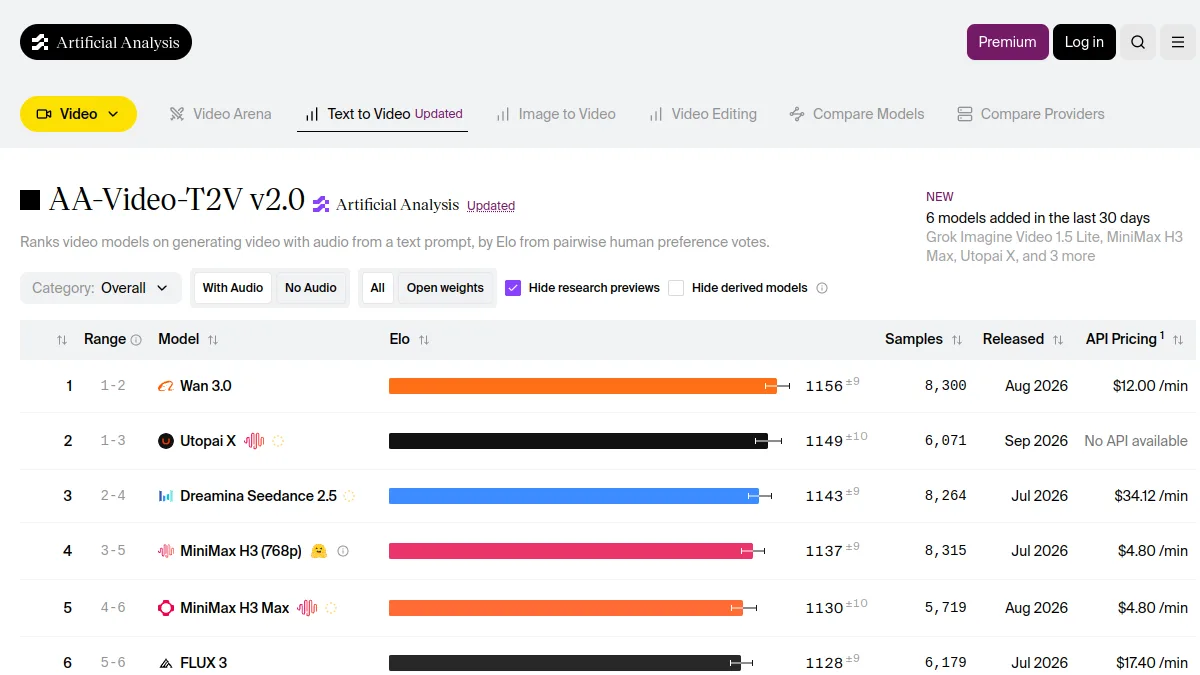
As for closed models, Wan 3.0 has a real heading with its 30 seconds of one holding: for a dilogued scene or a product demonstration, we avoid connections between several 10-second clips, always a little visible. Fashion « Reference to Video » inherited from Wan 2.6 also helps keep the same character from one plan to another.
The limits now. The interface is in English and there is no help in French. Prices are difficult to read and often change. Moderation follows strict rules, particularly on public figures and certain political subjects. And as with any service hosted outside Europe, we avoid sending customer faces or confidential documents without reading the privacy policy. Finally, quality depends heavily on speed: where Kling « guess » often what you want, Wan rewards precise framing and movement descriptions.
Wan vs Kling vs. Seedance : Which Should You Choose ?
The three are leading Chinese models, but they are not intended for the same use.
| Criteria | Wan (Alibaba) | Kling (Kuaishou) | Seedance 2.0 (ByteDance) |
|---|---|---|---|
| Open source | Yes for 2.1 and 2.2 | No | No |
| Max duration of a clip | 30 s (Wan 3.0) | Variable according to model and plan, possible extension | 4-15 s |
| Native | Yes since 2.5 | Yes on recent models | Yes, with very precise labial synchronization |
| Free access | Unlimited local or daily credits | Daily credits | Daily credits via Dreamina |
| Ideal for | Bidouilleurs, long clips, total control | Start, realism of movements | Content with dialogue, advertising |
Wan 2.5 vs Kling: Which Should You Choose ?
For someone who starts and wants realistic videos without fighting with settings, Kling remains our first advice. Its interface is more accessible, the Francophone community is wider, and its free credits allow to test seriously every day (we detail them in our guide Free Kling AI). Wan takes the advantage if you want to work locally, integrate the generation into an automated pipeline, or produce plans of more than 15 seconds with Wan 3.0.
Wan vs. Seedance 2.0
Seedance 2.0, released in February 2026 at ByteDance, generates image and sound in a single pass with a labial synchronization to the phoneme, and accepts numerous input references (images, videos, sounds). For an advertising hook or a spoken scene of a few seconds, it's him we choose. Wan 3.0 exceeds it over the duration of a single clip and on inputs « documents » (transform a web page or video presentation). Our review complete on Seedance 2.0 details its forces and limits of access.
And if none of the three are right for you (interface in English, moderation, price), other options exist: PixVerse is very good for viral effects and social media formats, and our list ofalternatives to Kling AI Also covers Hailuo, Runway or Veo.
🎯 Verdict
Wan is the most interesting family of the moment for those who want to understand and control the video generation: Wan 2.2 locally is free, open and commercially usable, and Wan 3.0 online pushes clips to 30 seconds. But it's not the simplest. To start in French, Kling remains more comfortable; for synchronised spoken scenes, Seedance 2.0 keeps the advantage. Wan 2.5 is more than an intermediate version: if a platform offers it, ask yourself if a newer version is not available at the same price.
FAQ: Wan AI
Who created Wan AI?
Wan is developed by Alibaba, in its Tongyi laboratory, and distributed via the create.wan.video platform, the API Alibaba Cloud Model Studio and, for open versions, GitHub and Hugging Face.
Is Wan 2.5 open source?
No. As of October 11, 2026, only Wan 2.1 and Wan 2.2 (and their variants) are licensed under Apache 2.0. Wan 2.5, 2.6, 2.7 and 3.0 are only available online or via API.
Can we use Wan AI in French?
The model includes prompts in French, but the interface of the official platform is in English. Prompt English results are generally more predictable.
What graphics card does Wan 2.2 need locally?
The official documentation indicates 24 GB of video memory for the TI2V-5B model, with an RTX 4090 example, and 80 GB for the A14B models on a single map. Compressed versions of the community make it possible to descend lower, slower.
Can we use Wan videos commercially?
With Wan 2.1 or 2.2 locally, the Apache 2.0 license allows. On the online platform or via a reseller, the terms of the service and your formula apply: check them before a customer use.