You generate a video with Kling, Sora or Synthesia, you publish it on YouTube And someone takes it back without asking you. Can you stop it? And on the other hand, does the video really belong to you, or the editor of the tool Does he have any rights on it? These questions constantly come back to creators, and the answers that circulate are often wrong in one direction or the other. An update is given on what the Intellectual Property Code, case law, and the conditions of tools and rules YouTube October 11, 2026. A reminder before starting: this article explains the general framework, it does not replace the review a lawyer on a specific file.
📌 Essentials
- A 100% video generated by AI is in principle not protected by copyright in France: it takes a natural person and creative choices that bear the imprint of his personality.
- A simple prompt is not enough to make you the author. The editing, script, selection and retouching can count.
- « Not protected » Doesn't mean « royalty-free » : the conditions of the tool music, an existing face or character may limit what you do with the video.
- Commercial use: a lot of tools reserve it to the paying formulas (Mubert from the Pro plan, for example).
- YouTube accept monetization of videos AI, but not mass content produced without actual input, and requires reporting realistic modified or synthetic content.
Contents: Royalty-free ? • Copyright requirements • Who owns the video • And the images ChatGPT ? • The American case • Real risks • Monetize on YouTube • Checklist • FAQ
The videos generated by AI are they royalty-free ?
The short answer: often no one owns copyright on a video entirely generated by AI, but it is not « royalty-free » in the sense that you usually hear it. We have to separate three questions, which we almost always mix.
- Is the video protected by copyright? It is the question of whether you (or someone) can forbid others to copy it. For a raw generation, the answer is generally not in French law.
- What does the contract say with l tool ? The conditions of use of Kling, Synthesia, Runway or Mubert determine what you have the right to do with the result: commercial or non-commercial use, watermark, mandatory mention. This contract applies even if the video is not protected.
- Is the video reproducing something that belongs to someone else? A well-known character, music, face or voice of a real person, a logo. There, it is the rights of third parties that play, and they are real.
In other words, a AI video can be both unprotected (anyone can reuse it) and not freely exploitable by you (because your free formula prohibits commercial use, or because it imitates a Pixar character). It is this double reading that avoids bad surprises.
What are the conditions for copyright?
In France, Article L111-1 of the Intellectual Property Code grants a right to « author of a work of the spirit » by its creation alone, without deposit or formality. Two conditions are laid down in the texts and case law:
- A natural person author. French copyright is built around the person who creates. No court has so far recognised a AI as author.
- An original work, That is, it bears the imprint of the personality of its author. The Court of Justice of the European Union speaks of « free and creative choices ». She also recalled on 4 December 2025 in two cases on the applied arts (C-580/23 and C-795/23): what counts is the choices made by humans, not the effort or the time spent.
For a AI video Thus, everything is played on the part of identifiable human choices. No French court has yet, to our knowledge, issued a decision in principle on a video generated by AI. Beware of articles that quote specific judgments on Midjourney or Sora in France: several references that circulate are not found in the official bases.
Is it enough to make you the author?
No, not in the rule of law. A prompt, even long and worked, describes an idea; But ideas are not protected, only their shaping is. And with a video generator, the concrete form (accurate framing, movements, light, faces) is decided by the model, not by you. The same prompt revived gives a different result each time, which shows that you do not control the final shape. It is also the position of the US Copyright Office, we go back to it.
Which can make a AI video protectionable
The situation changes as soon as your intervention exceeds the prompt. Several elements can carry your footprint and therefore be protected, even if each plan has been generated:
- The scenario and the text that you wrote, the voiceover that you wrote.
- The editing : order of plans, rhythm, cuts, association with music. An original compilation of generated plans can be a work in itself.
- Your own starting images (photo, drawing, storyboard) animated by the AI They remain your work.
- Substantial alterations image by image, calibration, effects added by hand.
In this case, it is the whole or these contributions that are protected, not each gross plan out of the generator. Practical advice: keep track of your work (scripts, versions of the editing, project files, steps taken). In case of dispute, this will prove your human contribution.
Who owns a AI video : you,tool Or anyone?
As copyright does not regulate everything, it is the conditions of use that organize the relationship between you and the publisher. The general trend:tool leaves you the result, but retains a license on what you send and reserves commercial use to the paid forms. Here's what we found out about a few tools in October 2026:
| Tool | To whom the result goes | Commercial use | Attention |
|---|---|---|---|
| Synthesia | To the client: videos are part of the « Customer Data » | Paid formulas, with limits according to plan | Avatars and technology remain at Synthesia |
| Mubert (music) | Licence to use according to plan | No for Ambassador (free) and Creator; yes from Pro | Forbidden to redistribute track alone as music |
| Kling AI | User, with a broad license granted to the publisher on content | Combined with the formulas paid according to the guides consulted | Free creations often public; reread the CGU before customer use |
| OpenAI (ChatGPT Sora) | OpenAI assigns to the user any rights to the generated content | Authorised in accordance with the rules of use | Restrictions on real people and misleading content |
For Synthesia, official conditions of use provide that the customer's data, including generated videos, is owned by the customer, while the platform, stock avatars and improvements remain the property of the customer. Synthesia. It is a contractual clause: it gives you the rights to Synthesia, not necessarily in front of third parties, since a video with no creative input remains difficult to protect.
For Mubert, the official grid is very clear: the plan Ambassador (free) and the plan Creator (14 $ per month, 11.69 $ in annual) are reserved for non-commercial use, monetization begins with Pro (39 $ per month, 32.49 $ annual), and Business (199 $, 149,29 $ annual) covers work for clients, applications and games. If your channel YouTube is monetized, so it's Pro at least. Other options are detailed in our guide on the music AI free of rights YouTube.
Do the images generated by ChatGPT are free of charge?
Same logic. Conditions OpenAI provide that the user owns what he provides, and that OpenAI assigns to her any rights she may have in the result. So you can use an image ChatGPT or a Sora video, including commercially, as long as you respect the rules of use. But this assignment does not create a copyright that does not exist: if the image is the result of a prompt without retouching, a competitor who takes it back probably does not counterfeit.
The real trap with ChatGPT is elsewhere: images « in the style of » a studio, or reproducing an existing character. The style itself is not protected, but a recognizable character, and a registered trademark too. An image of Mickey generated by AI remains a reproduction of Mickey.
And in the United States, where most of the tools ?
The United States reached the same conclusion on another path, and the issue was further resolved. Three benchmarks:
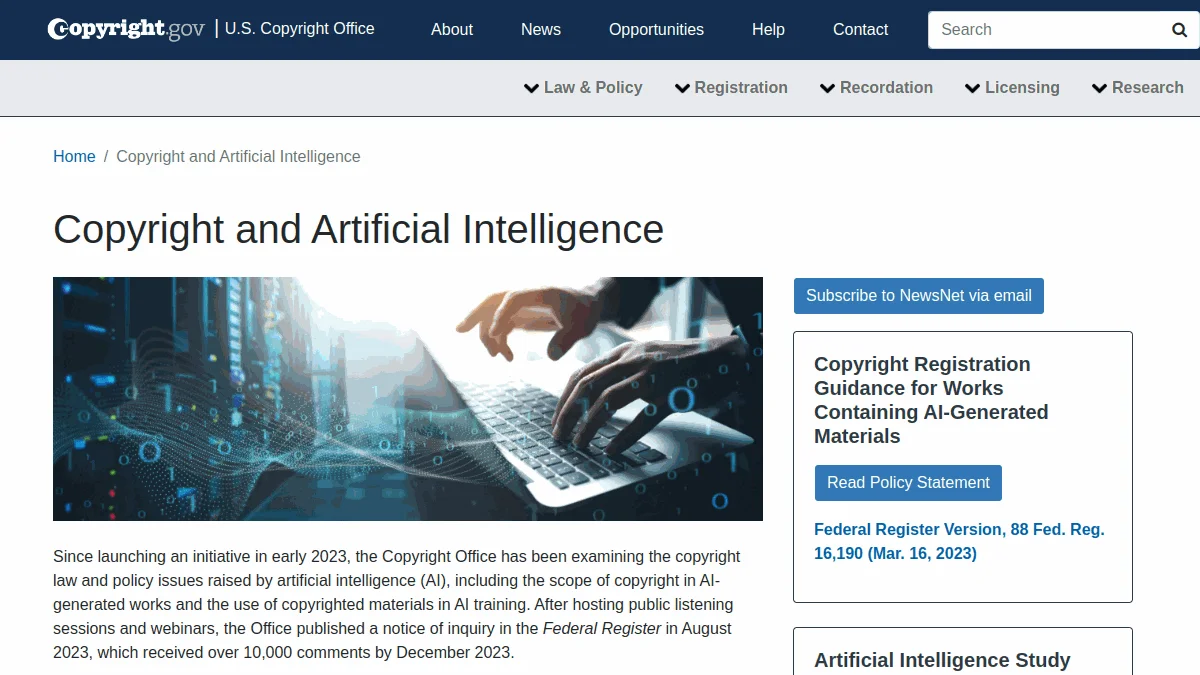
- The report of the Copyright Office on the protection of generated content (Part 2, published in January 2025), concludes that prompts alone do not give sufficient control, but that a work combining human input and AI can be registered for its human part (selection, layout, modifications).
- Thaler v. Perlmutter: The Columbia District Federal Court of Appeal confirmed on March 18, 2025 that a work must have a human author. The Supreme Court refused to consider the appeal on 2 March 2026, leaving the decision in place.
- In practice, The Office records works containing AI, provided that the parties generated are declared and excluded.
The documents are public on the page of the Copyright Office dedicated to the AI. For a French creator, it is especially useful to understand the logic of tools and because a video broadcast in the United States will be judged according to these rules.
Real risks: counterfeiting, faces, voices and labelling
For a creator, the main legal risk is not « lose » his AI video It is to infringe someone else's rights without realizing it. The most common situations are:
- A character, a decor or a recognizable plan a film or a game: it is a reproduction, even if AI Ia « redesigned ».
- The face or voice of a real person without his consent: right to image, infringement of privacy, and according to the context criminal offence for deceptive montages. A full article was devoted to: Are deepfakes legal in France.
- A protected music added to editing or too closely imitated by a generator musical.
- A logo or a brand which appears in the generated plan, especially in an advertising video.
Adds the transparency obligation of the European Regulation on AI Since 2 August 2026, content of the deepfake type (realistic images, sounds or videos that could be considered authentic) must be reported as generated or manipulated by AI, with arrangements for works clearly artistic or satirical. The detail is in our article on thelabelling of AI videos since 2 August 2026.
Training AI : the presumption voted in the Senate
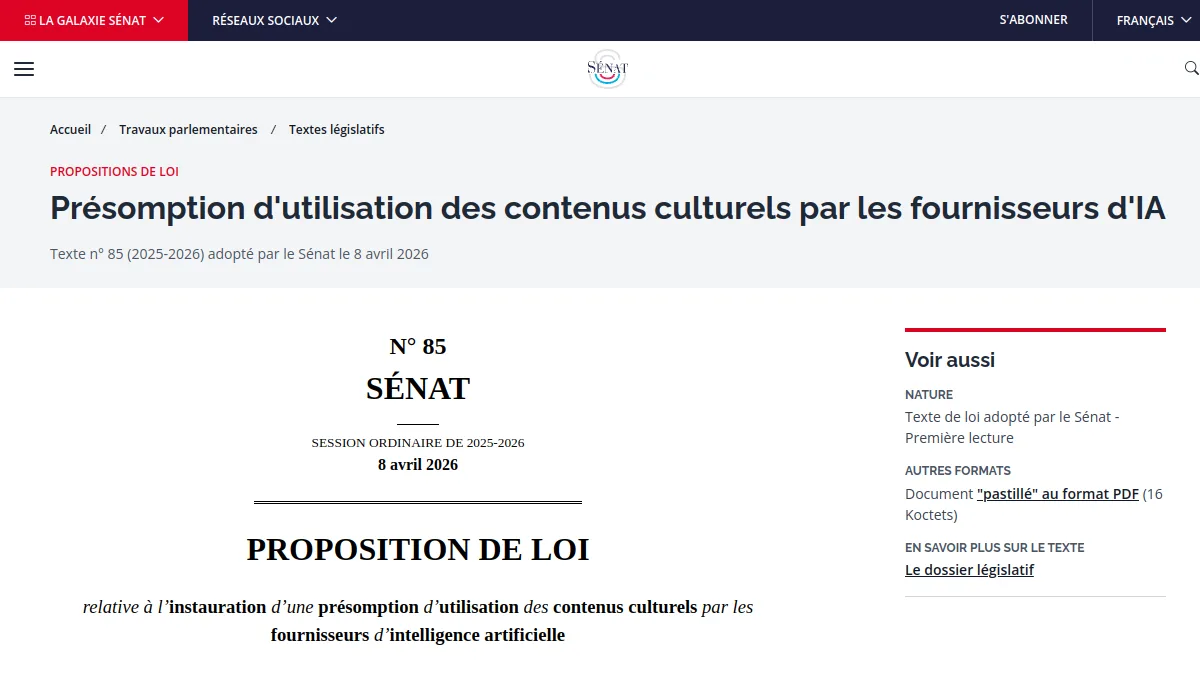
Another debate is taking place in parallel, concerning publishers.AI rather than users. On April 8, 2026, the Senate unanimously passed a bill that creates a presumption of cultural content being used by suppliers of cultural content.AI : an author would no longer have to prove that his work was used to lead a model, serious clues would suffice, on the charge of the publisher to prove otherwise. The text is available on Senate website ; It was forwarded to the National Assembly and was not definitively adopted at the time of writing. For you, user, this does not change anything in the short term, but it could push the tools to review their licenses.
Can we monetize a AI video on YouTube ?
Yeah, but not just how. YouTube does not prohibit AI in its partner program. What he refuses is the said content. « inauthentic » : a rule known in July 2025, then detailed in mid-July 2026, which targets videos produced in mass on the same model, repetitive, without significant input from the creator, as well as the AI avatars who pretend to be human experts in health, law or finance. A channel that publishes 30 AI videos a day with the same synthetic voice and interchangeable visuals is in the viewfinder, that she uses the AI or not. A channel that plays, comments, climbs and brings a look remains eligible.
Two other rules count. First, the mention of modified or synthetic content: when posting online, YouTube ask to check a box when a realistic video has been generated or retouched significantly (a person who says what she did not say, an event that did not occur). Next, Content ID: a music generated by a tool without a suitable license, or a track that looks too much like an existing title, can trigger a claim and divert your revenue. Our file on the monetization YouTube videos AI details the criteria and cases of demonisation.
⚠️ Attention: a AI video Unprotected can be taken over by other channels, and you will find it difficult to have it removed by a copyright infringement claim. Plus your contribution (script, voice, editing) is visible, the more arguments you have, legal as with YouTube.
Before you publish: the right checklist of a video AI
This list is used before each publication of a video containing generated plans. It takes two minutes and avoids much trouble.
- Does my formula allow the intended use? Commercial, customer, monetized: check the grid tool video, by tool by vote and vote tool One by one.
- Is the watermark removed legally? Removing it by hand on a free video may violate the conditions of the tool.
- Is there a real face, voice, name or logo? If yes, do you agree with the person or brand?
- Is an existing character or universe recognizable? If so, rework or give up.
- Is the video realistic enough to deceive? Activate the synthetic content statement on YouTube And clearly label it.
- Did you keep track of your work? Scripts, project files, versions: they prove your creative contribution if one day the question arises.
For projects at stake (advertising, film broadcast, work for a client), reread the conditions of the tools by a lawyer and plan in your contracts that bear the risk if generated content is a problem. Major agencies already do so systematically.
🎯 Verdict
A video generated from a single prompt is in practice owned by no one within the meaning of copyright, but you can use it within the limits of the conditions of the tool. What really protects you is your contribution: scenario, voice, editing, touch up. And what really exposes you is not the plans generated themselves, but what they take back to others: faces, voices, music, characters. Choose formulas that allow commercial use as soon as you monetize, and keep track of your work.
FAQ: AI video and copyright
A video generated by AI Is it protected by copyright in France?
Not if it is generated without human creative intervention. French copyright presupposes a natural person and an original work, which bears the imprint of his personality. The scenario, the editing or the alterations you add can be protected.
Can we reuse the AI video Another creator?
If the video is a raw generation, its recovery is probably not a counterfeit. But it can contain protected elements (voiceover music, editing and recovery may constitute parasitism or violate the rules of the platform. Better get the deal.
Is it worth mentioning?tool d AI Used?
Some free packages require a mention or leave a watermark. Irrespective of the contract, realistic content that might be misleading should be reported as generated by AI on YouTube as under the European Regulation on AI since 2 August 2026.
Can we drop a AI video To protect her?
In France, copyright is created without deposit. A deposit (Soleau envelope, Commissioner of Justice, time stamping) is only used to date your work. It does not make a video that is not protected, but it helps to prove your creative contribution.
The music generated by AI Is she royalty-free for YouTube ?
This depends on the license of the tool. At Mubert, for example, monetisation is permitted only from the Pro plan. With a suitable license, the music can be used in a monetized video, but not redistributed alone as a song.