
Since Sunday 2 August 2026, Article 50 of the European Regulation onartificial intelligence is in force. Behind this issue is a very concrete question for anyone who publishes videos made or edited by AI : Should we now say that, and in what form?
The answer depends on a criterion that most articles on the subject are silent, and that decides everything: the professional nature of your activity. Two people can publish exactly the same video generated by Kling or Veo, one being required to report it, the other not at all. This is where the line passes, and what you have to do now.
📌 Essentials
- Implemented since 2 August 2026Article 50 of the European Regulation onAI.
- If you monetize (chain, customer, service, brand), you are a deployer: you must report deepfakes and content imitating the real.
- If your use is strictly personal and non-professionalYou're not in the perimeter.
- The tools have the obligation to incorporate a machine-readable mark: part of the work is not yours.
- Official EU icons exist, are free and free, but their use remains optional.
Updated August 2, 2026: the regulation passed in general application this Sunday. The European Commission confirms that 2 August 2026 is indeed the date of general application of the text, and that the rules on transparency are part of it. However, the technical specification of machine-readable marking is still not standardized, even though the requirement is now running.
Contents: What Article 50 requires • Are you concerned? • What to report • What the tools do already • How to report it • Exceptions • Penalties • FAQ
What Article 50 really imposes since 2 August 2026
The European Regulation onAI came into force in 2024, but its obligations turn on in steps. The August 2, 2026 issue deals with transparency, and it is the first that directly affects content creators. The European Commission published its implementation guidelines on 20 July 2026, less than two weeks before the deadline.
The text divides the duties between two roles. Suppliers, i.e. publishers of generators that you are using, must do two things: notify the user that he or she is addressing a AI, and integrate into the produced files a machine-readable mark. The deployers, i.e. those who use these tools in the course of their activity, must make the information visible to the public.
This separation is good news for creators: the technical part of the marking is not your problem, it is that of the publisher of thetool. Your share is limited to the display, and it is much simpler to process.
Are you concerned? The line goes through professional use
The definition of the deployer in the regulations refers to any natural or legal person who uses a system ofAI under his responsibility. But there is an explicit exclusion: use for personal and non-professional purposes. That's where your situation is.
You monetize or work for a client: you are concerned
Chain YouTube services contracts, content for a brand, freelance in editing, agency, shop that produces its own advertisements: in all these cases, the activity is professional and you fall into the category of deployers. The criterion is neither the number of subscribers nor turnover, but the professional nature of usage.
In other words, a small channel that reaches a few tens of euros a month is involved, while a 100 thousand subscribers who are purely recreational and not monetized is not. If you have already looked at the monetization of AI videos on YouTube, you already know this logic: what triggers bonds is the shift in an economic activity.
You publish for fun: you are not targeted
A video generated to make your loved ones laugh, a test oftool published without any counterpart, an aesthetic experiment: Article 50 does not impose anything on you. The European Regulation does not seek to police private use, it governs economic actors.
⚠️ Attention: The exemption from personal use applies to the European Regulation onAINot for the rest of the law. Publishing a deepfake of a real person without his consent remains punishable in France under the right to the image and penal provisions on montages, whether you are amateur or professional.
What exactly should you report?
If you are a deployer, the obligation does not cover everything you publish without distinction. The guidelines focus on content that mimics reality.
The first, the most clear case, is that of deepfakes: a video or audio that reproduces an existing person, or that stages an event presented as real while it is not. A voice cloned in an advertisement, a substituted face, a manufactured news scene fall into this category. The second case concerns texts intended to inform the public on matters of general interest. The third, rarer for a creator, focuses on recognition of emotions and biometric categorization.
A clearly fictional video, an abstract illustration plan or a stylized animation do not fall within the same logic: they imitate nothing real, so they do not deceive anyone. This is the spirit of the text, and it covers much of the current video production AI. The regulation targets confusion with reality, not machine-assisted creation in general.
What the tools do already in your place
Suppliers must incorporate in their outputs a machine-readable mark: invisible watermark, metadata, signature of provenance. This technical layer is in their hands, not yours, and is already partially in place in several publishers.
There is a shade to know, however, because she can play tricks. These marks survive manipulations badly: a reencoding, a tight cropping, a screen capture or a passage through a video editing software may erase them, in whole or in part. A file can therefore be authentically generated by AI and no trace can be detected. This is the well-known limit of Video detectors AI, and explains why the visible alert remains useful.
How to report without sabotaging your video
It is the most common fear among creators: to display « generated by AI » or penalise the broadcast. The regulation does not impose a single wording, a specific location, or a size: it imposes a function, that of informing the public in an accessible manner. This flexibility leaves you with a margin.
Several forms fulfil the obligation. A statement at the beginning of the description, a discreet inlay on the first seconds, a line in the generic, or label « summary content » already proposed by large platforms. This last option is often the most economical: the declaration is made by sending, and the platform displays the wording in its own way. On short formats, where the AI Tools for TikTok have become largely commonplace, the check box at the time of publication does the work.
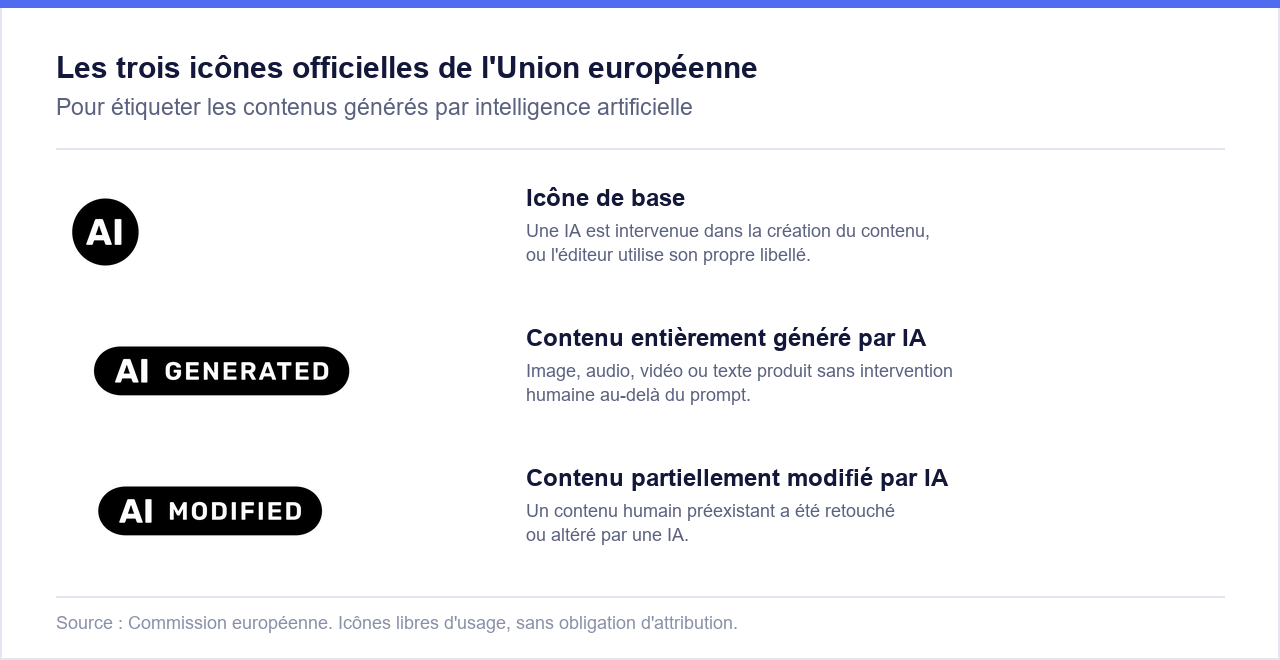
The European Union has also published a set of three official icons: a basic icon, one for the content entirely generated by AI, one for human content partially modified by AI. They exist in four colour variants, in SVG and PNG, and the Commission makes them freely available, without any obligation to award them. Be careful not to reverse the rule: these icons are optional, the obligation to report is not.
💡 Tip: separate your two production streams. Videos that mimic the real (visage, voice, news scene) receive a systematic mention. Obviously fictional videos don't need it. Sorting upstream avoids placing a label everywhere as a precaution, which dilutes information and does not bring anything.
The European regulation sets a floor, not a ceiling. The platforms go further and on another ground: since July 2026, Snapchat no longer recommends videos entirely generated by AI on Spotlight. Reporting content in accordance with the European text therefore does not guarantee that it will be distributed.
The exceptions provided for in the text
Two adjustments deserve to be known. The first concerns content subject to human editorial control: where a text of general interest has been read by a human and a person or entity assumes editorial responsibility, the reporting obligation falls. The logic is clear, what the regulation wants to avoid is automatic publication without identifiable responsibility.
The second concerns artistic, satirical and fictional works. The text provides for proportionate adjustments: information must be given, but without damaging the work. We won't ask you to stamp a parody in the middle of it. However, the practical implementation of this grade is not yet documented, and it would be imprudent to use it as a general pass-right.
| Your situation | Concerned since 2 August 2026 | What You Do |
|---|---|---|
| Monetized chain, deepfake or realistic scene | Yes | Visible Mention or Platform Label |
| Monetized channel, clearly fictional content | In principle no | Nothing mandatory |
| Benefit for a client | Yes | Mention, and clause in the estimate |
| Personal publication not monetized | No | Outside the scope of the Regulation |
What penalties for non-compliance
The scheme is set out in Article 99 of the Regulation. For failure to comply with the transparency requirements of Article 50, the ceiling shall be EUR 15 million or 3 per cent of the world's annual turnover, whichever is higher. These figures are calibrated for industrial actors and are obviously not intended to apply as such to an independent creator.
For small and medium-sized enterprises, the rule is the opposite: the lowest of the two amounts applies. These are in all cases ceilings, not tariffs, and the national authorities are proportionate to the sanction. The real risk for a creator is rather on the side of platforms: their own rules on undeclared summary content produce effects much faster than a European procedure. The question of the legal liability of synthetic content in France deserves a detour, we have dealt with the legal framework for deepfakes in France.
What remains unclear on the day of implementation
I might as well say it frankly: the device is incomplete. The technical specification of machine-readable marking is not standardized, whereas the requirement is now in force. The observation was noted by several observers in the sector, including the Journal du Net on 24 July 2026.
Practical consequence: each publisher marks in its own way, no universal player exists, and automated verification will remain in check for a while. A Code of good practice on the transparency of content generated by AI should clarify these modalities and harmonise usages between voluntary actors. The real effectiveness of the system depends on it, more than on the regulation.
🎯 Verdict
For a creator who monetizes, compliance is a habit, not a construction site: to report videos that mimic the real, and to leave those that do not deceive anyone alone. The box « summary content » Platforms are sufficient in most cases. The real blur is not in your obligations, it is in the technical layer that Europe has not yet delivered, and which is under the responsibility of the publishers oftools.
Frequently Asked Questions
Should all videos generated by AI ?
No. The obligation focuses on content that mimics the real, deepfakes and scenes presented as genuine. A video that is clearly fictional or abstract does not create confusion and is not subject to the same requirement. And if your use is strictly personal and unprofessional, you are not deployer within the meaning of the regulations.
Is an amateur YouTubeur concerned by article 50?
Not if he does not engage in any professional activity with these contents. The definition of deployer excludes non-professional personal use. Once there is monetization, partnership or benefit for a third party, the activity becomes professional and the obligations apply.
Must the mention be visible on the video itself?
The regulation imposes a function, informing the public in an accessible manner, without setting mandatory location. A description at the top, an inlay at the beginning of the video or the synthesis label proposed by the platform can fulfil this function.
Are official EU icons mandatory?
No, their use is optional, and they are royalty-free without attribution. The labelling requirement is binding, not the visual used to wear it. Home language is acceptable if it informs correctly.
What happens if the watermarktool disappears in editing ?
Machine-readable marks are poorly resistant to recoding, cropping and screen capture. Their integration is the responsibility of the supplier oftool. As a deployer, your obligation is to inform the public, regardless of the persistence of the technical marking.
Does the Regulation apply to tools Not European?
Yes, as long astool is proposed on the Union market or its results are used. One generator American or Chinese used from France falls within the scope of the text.
To go further
- European Commission guidelines transparency obligations, 20 July 2026
- Official EU Icons for labelling of content generated by AI
- Text of Article 50 of the European Regulation onAI
- Article 99, sanctions regime