Snap published on July 31, 2026 a discreet but heavy update for all those who post video generated by AI. Videos entirely produced by a AI are no longer eligible for the recommendations on Spotlight, Snapchat's discovery thread. In other words: they can still exist on the platform, but the algorithm will no longer push them towards new spectators.
📌 Essentials
- What changes: since July 2026, the videos « entirely generated by AI » are no longer eligible for Spotlight recommendations.
- What doesn't change: Snap does not speak of deletion, account suspension, or pay cut. The text refers only to the recommendation.
- Exception: a video retouched with the AI Tools house of Snapchat remains recommendable, with an indicator of transparency.
- Context: Snapchat joined YouTube and TikTok in the fight against« AI slop », these contents AI mass-produced repeaters.
- Dead corner: Snap himself admits that« no detection system is perfect ».
Contents: The announcement of 31 July · What the rule really changes · What is the AI slop · What remains eligible · How Snapchat Will Detect · Where are we? YouTube and TikTok · What to do in practice · FAQ
What exactly announced Snapchat on July 31, 2026?
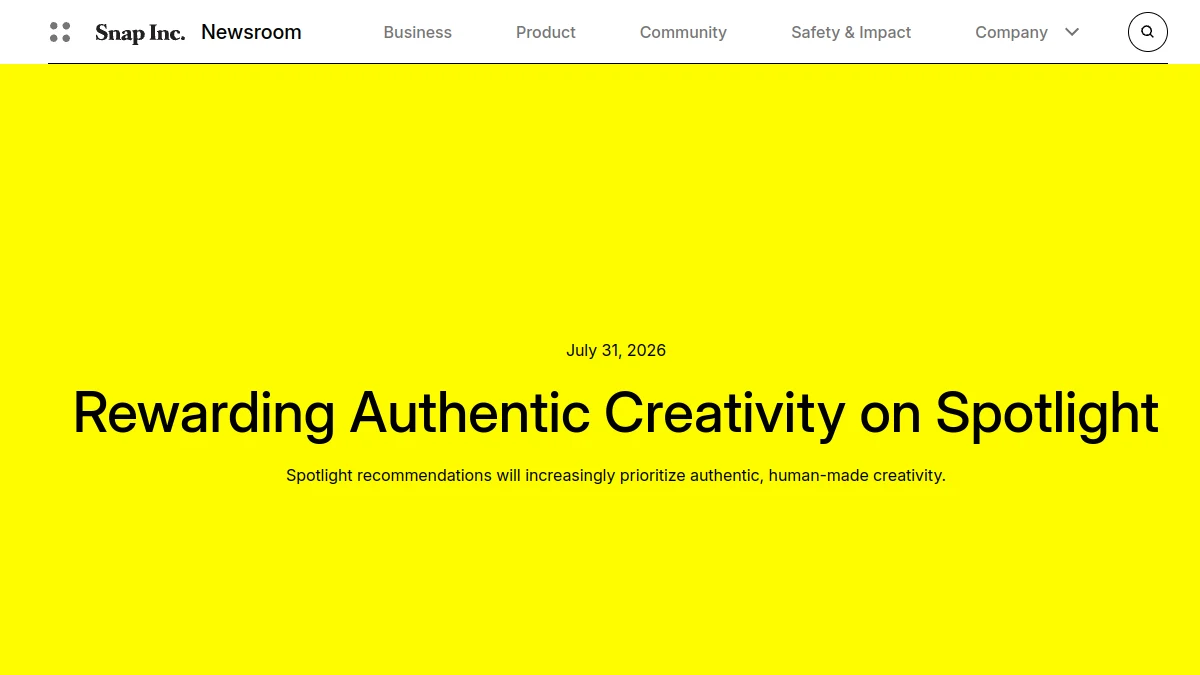
The advertisement holds a post published on Snap Inc.'s newsroom entitled « Rewarding Authentic Creativity on Spotlight ». The subtitle gives the direction: Spotlight recommendations go « more and more giving priority to authentic creativity, made by humans ».
The sentence that counts is this, translated from the original text: « From this month onwards and for the rest, the videos generated entirely by AI will no longer be eligible for Spotlight recommendations. » Snap uses the word Wholly, entirely. It is a choice of vocabulary that weighs, and we come back below it.
Snap justifies the decision by saturation: « As content generated by AI, low quality and repetitive, become increasingly common on the internet », the company says it wants Spotlight to remain a place where it discovers « authentic creativity of real people ».
Only one figure is put forward in the ticket, and it serves as Snap's argument: the number of unique contributors to Spotlight worldwide would have increased by more than 120% over a year. It's a home data, unaudited, and it measures the number of people who post, not the quality of what is posted. Take it for what it is.
Recommendation, monetization, deletion: what really changes the rule?
That's the point where much of the press coverage went too fast. Several titles announced that Snapchat « banished » videos AI, or that he stopped « Pay ». Snap's text says neither.
What the note states, very precisely, is a loss ofeligibility for recommendations. Three distinct things are at stake, and it is worth separating them.
| Mechanism | What the July 31 announcement says |
|---|---|
| Recommendation (algorithm pushes video to strangers) | Deleted for videos fully generated by AI. This is the only point explicitly decided. |
| Monetization (revenues paid to Spotlight creators) | Not mentioned. The word does not appear in the note. In practice, a video that is no longer recommended makes much fewer views, so the effect on income is real, but indirect. |
| Publication and hosting | Not mentioned. There is no indication that the videos will be removed, nor that the accounts will be punished. |
⚠️ Attention: the distinction is not a legal detail. On a discovery thread like Spotlight, the overwhelming majority of views come from the recommendation, not from subscribers. Losing eligibility means losing the bulk of the hearing without any formal prohibition.
What is it?« AI slop »And why are the platforms attacking it?
Expression AI slop in 2025 and 2026 to designate the content generated by AI mass produced, without editorial intent, for the sole purpose of filling a wire and capturing views. « Slop », in English, it's the pâtée : of the formless food, served in volume.
This is not a judgment on technology. A video made with a AI generator can be excellent. Slop is another thing: the industrial production of interchangeable variations, often in the same viral formats, often recycled from one platform to another.
The problem has become a platform problem for a simple reason: these content works well in the short term. They are quick to produce, calibrated for algorithm, and they saturate the wires. Except that if a user opens his application and finds only that, he ends up closing it. It's exactly the arbitration Snap describes when he talks about preserving « which has always made Spotlight special ».
The BBC The announcement was discussed on 31 July, presenting Snapchat as joining the other major platforms in the fight against AI slop. This is the right framing: Snap does not open a forehead, he joins one.
Which videos remain eligible for recommendations?
Snap takes care to defuse the trial in technophobia. The note says it black on white: « It is not a question of rejectingAI. » The company recognises thatAI holds an important place in the creative process of some, and that it can « unlocking new forms of expression ».
The dividing line therefore passes between two uses.
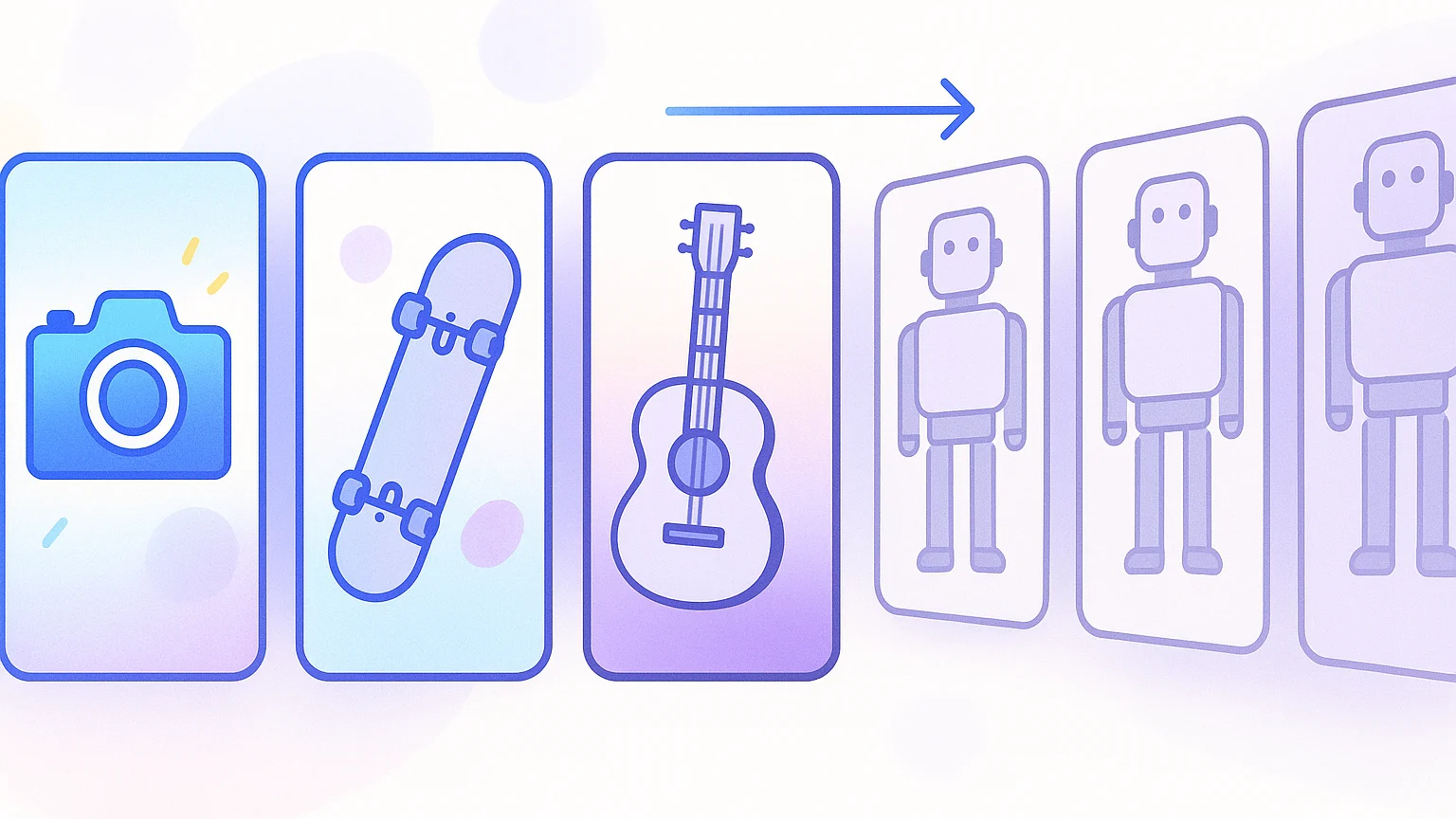
- Video fully generated by AI : more eligible for recommendations. This is the case of a clip produced from end to end by a model from a prompt, without shooting.
- Video shot then retouched or improved with the AI Tools Snapchat: always eligible and accompanied by transparency indicators.
This second point deserves to be read twice. Snap states that the exception concerns retouched content « with the tools Creative AI Snapchat », i.e. its own features. The ticket does not say what happens to a video shot by a human then mounted with a tool AI third. This is the main blur of the text, and it concerns many people.
💡 Tip: If your production is based on real shooting, keep track of your rushes. In the face of an automatic detection system, being able to demonstrate that there is a filmed source is the best recourse in case of incorrect ranking.
How will Snapchat spot videos 100% AI ?
The ticket does not detail any method. It does not mention metadata analysis, watermark, C2PA signature, or model classification. This is a significant gap for a rule based entirely on the ability to decide « Fully generated » against « not fully generated ».
Snap, however, makes an admission that it is rarely seen in this type of communication: « No detection system is perfect. » The sentence is short, and it says a lot. It means that there will be false positives, wrongly declassified human videos, and false negatives, AI videos which will continue to pass.
No challenge procedure is described in the note. For creators whose audience depends on Spotlight, this is probably the most uncomfortable point of the advertisement: a rule applied by an imperfect system, without documented recourse.
Snapchat, YouTubeTikTok: What is the status of the other platforms?
Snap's announcement fits into a short sequence. In July 2026, 20 Minutes a new measure of YouTube against videos AI, in line with its policy of monetization tightened on the content produced in series. TikTok, for his part, reported the same month on his deepfakes detection technology.
We have detailed the component YouTube in our article on monetization YouTube and AI videos in 2026, and TikTok in our guide of the AI Tools for TikTok. The movement is the same everywhere: platforms do not block production, they cut distribution.
We must add the regulatory framework, which moves exactly at the same time. Since 2 August 2026, the European Regulation onartificial intelligence requires that content generated by AI in the European Union. We have detailed what this means in practice in our article on what you will need to report from 2 August 2026.
The two logics are not confused, and it is important to understand it. Europe requires declare that content is generated by AI. Snapchat decides not to recommend. The first is a legal obligation of transparency, the second is a commercial distribution decision. A video can be perfectly in line with the European regulation and still invisible on Spotlight.
What to do if you publish AI videos ?
Some common sense adjustments, valid beyond the Snapchat case alone.
Reintroduction of humans into the chain
A plan shot on the phone opening, a real voice, a face, an identifiable place: everything that anchors the video in a real shoot makes it come out of the category « Fully generated ». It is also, incidentally, what makes it better.
Do not depend on one platform
Three platforms tightened their rules on AI video in a month. A broadcast stream based entirely on Spotlight, or entirely on Shorts, is exposed to a unilateral decision taken on Friday night.
Declare, even when not yet mandatory
Transparency indicators become the norm on both sides, both regulatory and platform. Make it a habit to report use ofAI Cost little and avoids being caught by an automatic detection which, it, will not ask your review.
Follow the rules at source
Spotlight's eligibility conditions are documented in Snapchat Help Center, and the full ad is readable on the newsroom of Snap Inc. The press covers simplify much, as we saw with the titles on a supposed banishment.
🎯 Verdict
Snapchat doesn't ban anything. He stops distributing. On a thread of discovery, the shade is legal more than practical: a video that is no longer recommended is a video that almost nobody will see.
The real signal is not Snapchat taken in isolation, it is convergence. In a few weeks, YouTube, TikTok, Snapchat and the European regulator all moved in the same direction. The video fully generated by AI remains perfectly legal and perfectly productable. It is simply becoming more and more difficult to circulate. For those who build an audience, the practical conclusion is:AI as tool in a chain that remains human passes,AI as a complete chain closes.
FAQ
Does Snapchat remove videos generated by AI ?
No. The announcement of 31 July 2026 concerns only eligibility for recommendations in Spotlight. Snap does not mention video deletion or account suspension. The videos remain publishable and visible by those who access the profile directly.
Does Snapchat stop paying for AI videos Spotlight?
Snap's note doesn't speak of remuneration, and the word "ne" does not appear. On the other hand, the effect is indirect but real: on Spotlight, the views come mostly from the recommendations. A video that is no longer recommended generates mechanically much less views, so much less revenue.
Can I still use it?AI To mount my Snapchat videos?
Yes. Snap specifies that improved or edited content with its own tools Creative AI remain eligible for recommendations, with transparency indicators. The text does not explicitly state the tools of the editing AI third parties applied to a toured video.
When does the rule apply?
Snap indicates that it applies « from this month and for the next »in a post published on July 31, 2026. The measure has therefore been effective since July 2026.
How does Snapchat know that a video is entirely generated by AI ?
The company does not describe any method of detection in its advertisement. However, it recognises that« no detection system is perfect », which leaves waiting for errors of classification in both directions. No challenge procedure is documented in the ticket.
Does this rule relate to the European Regulation on theAI ?
No, these are two distinct things. Since 2 August 2026, the European Regulation has required that content generated by AI This is a legal obligation of transparency. Snapchat's decision is a private distribution rule. A video that complies with the European regulation may however no longer be recommended on Spotlight.