
Tagshop AI is an AI-generated “UGC” video ad platform: you paste a product link or describe an idea, an agent asks a few questions, then the tool assembles a video with an avatar, a voice, subtitles and illustration shots. Three figures to remember as of October 31, 2026: the subscription starts at $29 per month ($14 per month billed annually) for 50 credits, i.e. “up to 5 videos” according to the publisher; the free plan is limited to 5 credits, once only; and payments are almost never refunded. This analysis is based on reading the publisher's official pages: the figures, the credit calculations and the limits below are attributed to it, and the verdict remains deliberately cautious.
Analysis based on the official Tagshop AI pages read on October 31, 2026. This page contains affiliate links.
Contents: Essential · What is Tagshop AI? · How it works · Prices · Credits · Free? · Strengths and Limits · Legality · Replacing creators? · Who is it for? · Verdict · FAQ
Essentials
- What it is: an “AI UGC” platform for e-commerce brands, SaaS, agencies and dropshippers. The publisher announces more than 300 avatars, more than 75 languages including French, an AI Video Agent, ad cloning (Ad Clone), creation from a product URL and a digital twin of yourself (AI Twin).
- Prices read on October 31, 2026: Starter $29 per month ($14 billed annually, i.e. $168 for 600 credits), Growth $69 ($39), Pro $129 ($79). Everything is in US dollars.
- Credits are charged per second of video. According to the publisher's table, the 50 credits of monthly Starter make about one 30-second video in Seedance 2.5 720p, or four in economical 480p. “Up to 5 videos” assumes short or economical clips.
- Free, yes, but tiny: 5 credits once only, for an image or a 4-second test video with a watermark. The 14-day trial no longer exists.
- Almost no refunds: never on a monthly plan, and on an annual plan only in a window of 3 to 7 days if no credit was consumed.
- What the pages don't say: the realism of the avatars, the quality of the French, the real cost of a complete 30-second ad, the quality of the agent. The publisher does not publish any measurement of them, so we do not assess them.
What is Tagshop AI, and what is meant by AI-generated UGC?
UGC means user generated contentcontent created by users. In advertising, the word refers to a specific format: a vertical video, filmed as if on a smartphone, in which a person talks about a product the way a customer would. Brands pay creators to produce them, then run them as ads on TikTok or Meta. We set out the framework, the human prices and the limits of the genre in our guide AI UGC: creating UGC ads with an avatar.
Tagshop AI (tagshop.ai) takes this idea all the way. Its slogan, “Make AI UGC Ads in Minutes”, sums up the promise: replace the creator and the shoot with a generated avatar, a script written by an AI and a synthetic voice. The publisher lists four recurring formats: the product review, the “problem then solution” testimonial, the tutorial or demo, and the unboxing. It targets e-commerce and “DTC” brands (which sell direct), software publishers, agencies, dropshippers and creators.
The home page also shows a reassurance banner: 4.9 on G2, more than 5,000 brands worldwide, no credit card required. These are figures declared by the publisher, which we could not verify. Keep them in their place: commercial dressing, not proof.
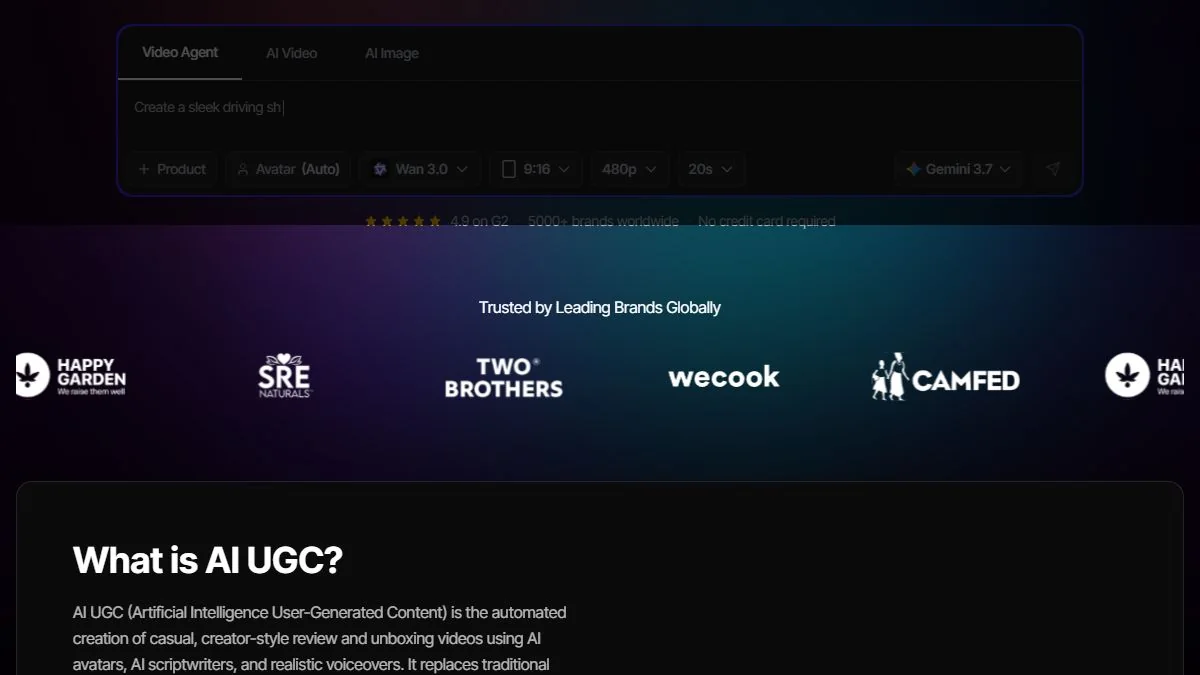
How does Tagshop AI work, according to the publisher?
Tagshop describes a three-step journey. You describe an idea or paste a product URL. You chat with the AI Video Agent, which asks questions about the brand, the message and the visuals. Then you get a complete video: script, avatar, voice, scenes, subtitles and illustration shots (the “B-roll”). The advertised time is 5 to 10 minutes per video on the pricing page, and 20 minutes at most for a first ad in the FAQ. These are publisher figures: the real time depends on the chosen model and the queue.
What does the AI Video Agent do?
This is the feature highlighted at the time we read the site (it carries the “New” label). Instead of filling in fields, you chat with an assistant that prepares the video. The idea is appealing for a beginner, because it avoids the blank page. What remains to be seen is how good the result is: an agent that asks good questions does not necessarily write a good script, and the publisher's pages do not let us judge.
What are Ad Clone, URL to Video and AI Twin for?
- Ad Clone recreates the style of an ad that works, using your own product. It is the classic move of acquisition teams: spot an ad that performs, reuse its structure, swap the product. Handle with care on the rights side, because you are reproducing someone else's staging.
- URL to Video pulls the images, the video and the description from a product page to turn them into an ad. Competitors have the same feature (we detail it in our Creatify review).
- AI Twin is a digital clone of yourself, used as an avatar. According to the publisher's help, creating it costs 1 credit, then a twin video costs 15 credits per minute, on all plans. It is the cheapest line of the whole credits table.
- Voice cloning, built-in editor, customizable automatic subtitles and more than 200 ad templates complete the list. The publisher also mentions videos where the avatar holds or wears the product: this is the trickiest point for any AI, and the publisher says no more about it.
What models, what languages, what formats?
Tagshop does not build everything itself: the site cites a long list of third-party models. On the video side: Seedance 2.0 and 2.5 (3.0 is announced as “coming soon”), Kling 3.0 and 4.0, Veo 3, Wan 2.7 and 3.0, Gemini Omni Flash, Grok Imagine Video, Hailuo 2.3 and Vidu Q3 Pro. On the image side: Seedream 5.0, GPT Image 2 and 2.5, Nano Banana Pro and 2, Flux 2 Pro, Ideogram 3 and Hunyuan Image 3. This “multi-model platform with credits” logic recalls that of Higgsfield, which we tested in our Higgsfield review : one buys a reserve of credits, then each model consumes it at its own pace.
The publisher announces more than 75 languages, French included, and the three usual formats: 9:16, 16:9 and 1:1. The plan comparison table mentions direct publishing of assets to TikTok (“Campaign management”). The help pages mention e-commerce integrations (Shopify, WooCommerce, Magento, BigCommerce): we have not verified them. As for how natural the French sounds, no page lets us judge.
How much does Tagshop AI cost in 2026?
The pricing page, read on October 31, 2026, offers three subscriptions with a monthly/annual toggle. Prices are in US dollars, and the site shows no euro equivalent. On annual billing, the cards show discounts of 51%, 44% and 39%.
| Plan | Monthly | Annual billing (per month) | Credits | Videos advertised |
|---|---|---|---|---|
| Starter | 29 $ | $14 ($168 per year) | 50 per month, or 600 per year | “Up to 5” per month, “up to 60” per year |
| Growth | 69 $ | $39 ($468 per year) | 150 per month or 1,800 per year | “Up to 15”, “up to 180” |
| Pro | 129 $ | $79 ($948 per year) | 300 per month or 3,600 per year | “Up to 30”, “up to 360” |
Starter already includes the essentials: Kling 4.0, Ad Clone, the AI Video Agent, more than 300 avatars, more than 200 ad templates, more than 75 languages, “fast” rendering, 1080p export, no watermark, chat and phone support, the AI Twin, URL to Video, the asset generator and voice cloning. Growth adds faster rendering, 4K export (according to the comparison table), 6 months of data retention and personalized onboarding. Pro adds the fastest rendering, 12 months of retention and a dedicated account manager. Beyond that, a custom plan exists for more than 50 UGC ads (on demo).
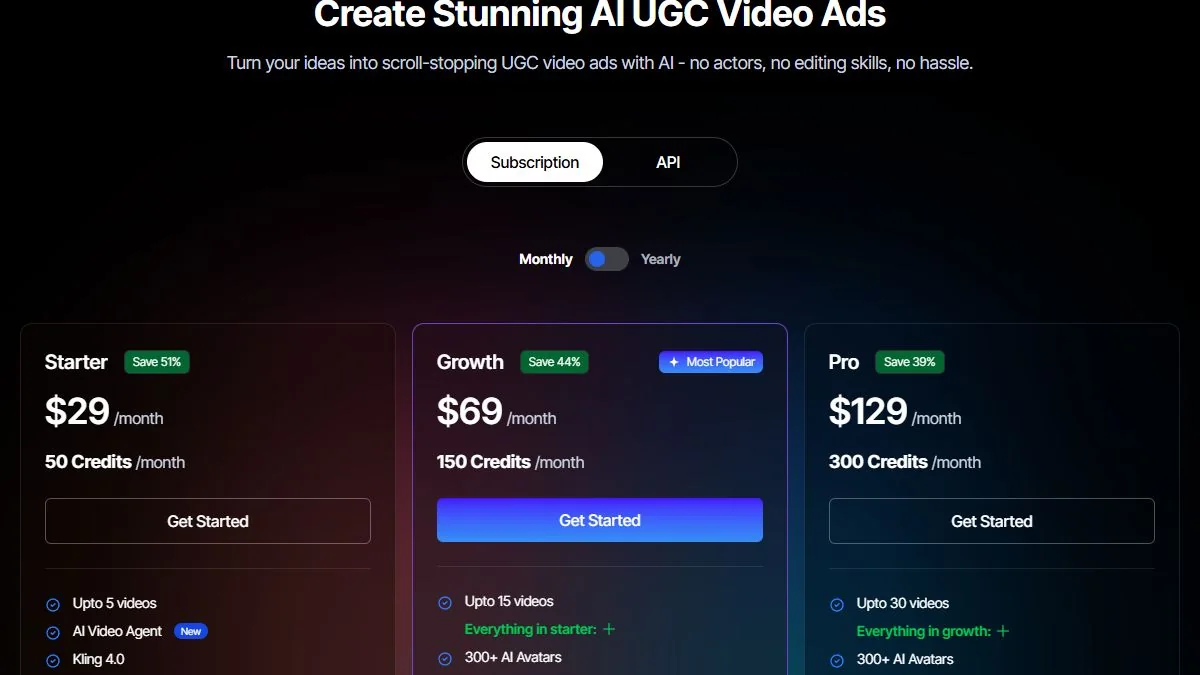
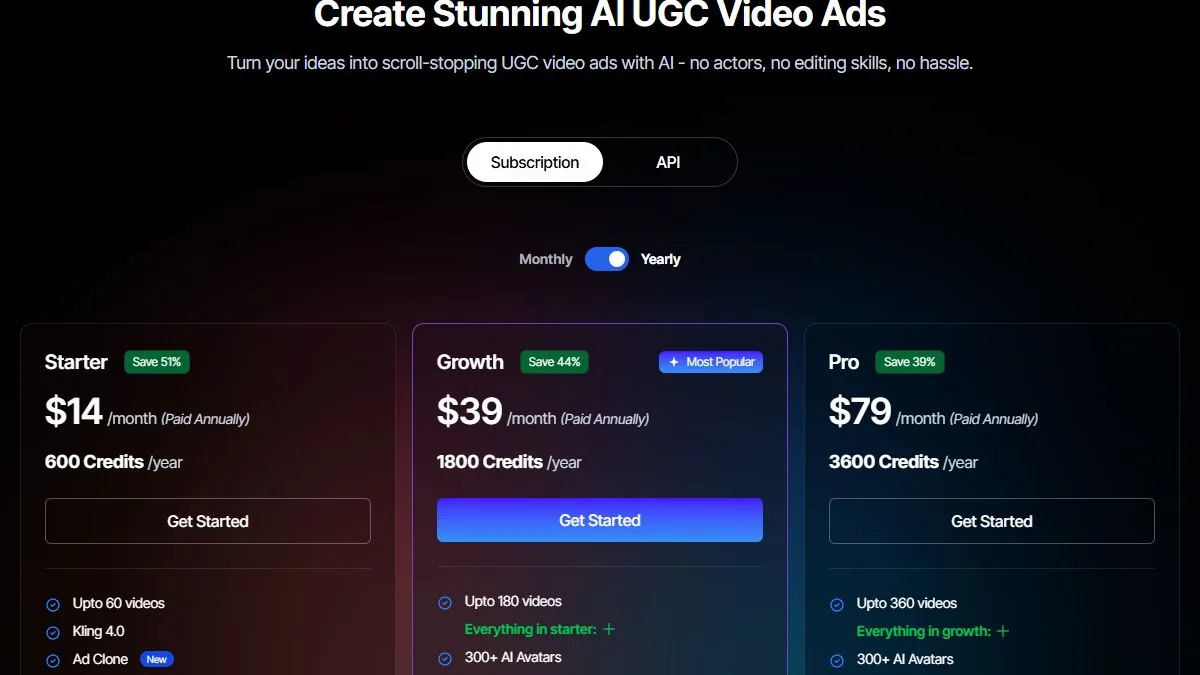
Three reading notes. First, the monthly/annual gap is huge on Starter: $29 versus $14, or $168 in one go for 600 credits. It is a real saving if the tool suits you, and a real risk if it does not, since we will see that the annual plan is refundable only in very narrow conditions. Next, data retention is short on Starter: 3 months. Download your finished videos rather than counting on the platform as an archive. Finally, cancellation is possible at any time from the Subscription tab, and access stays active until the end of the paid period.
On cost per video, the calculation is simple and should be read as a theoretical ceiling. Dividing the price by the “up to” number of videos gives about $5.80 per video on monthly Starter (29 divided by 5), $4.60 on Growth (69 divided by 15), $4.30 on Pro (129 divided by 30), and $2.80 on annual Starter (168 divided by 60). These amounts are minimums: the real number of videos depends on the model, the duration and the resolution, as the next section shows.
What are Tagshop AI's credits really worth?
This is the section that matters most for your budget. According to the “How Credits Work on Tagshop AI” help page (dated September 24, 2026, read on October 31), credits are charged per second of generated video, depending on the model and the resolution. Here is the publisher's table, in credits per second (Cr/s).
| Model | 480p | 720p | 1080p | 4K |
|---|---|---|---|---|
| Seedance 2.0 | 0,5 | 0,9 | 2,1 | 4,3 |
| Seedance 2.5 (recommended by the publisher) | 0,6 | 1,3 | 3,1 | no 4K |
| Seedance 2.0 Fast | 0,4 | 0,6 | not stated | not stated |
| Wan 3.0 | 0,3 | 0,5 | 1 | not stated |
The AI Twin sits outside this table: 15 credits per minute, whatever the plan. The publisher itself gives examples for 30 seconds of video: 12 credits in Seedance 2.0 Fast 480p, 15 in Wan 3.0 720p, 39 in Seedance 2.5 720p, 63 in Seedance 2.0 1080p, and 7.5 for a 30-second digital twin.
Translated into a budget (calculations from this table, not measurements):
- The monthly Starter and its 50 credits make about one 30-second video in Seedance 2.5 720p (50 divided by 39, or 1.3), four in Seedance 2.0 Fast 480p (50 divided by 12, or 4.2), but only 16 seconds in Seedance 2.5 1080p.
- Growth and its 150 credits make nearly four 30-second clips in Seedance 2.5 720p.
- The Pro and its 300 credits make about seven to eight.
- The “ up to 5 videos ” promised on Starter works out to 10 credits per video: about 8 seconds in Seedance 2.5 720p, or 25 seconds in Seedance 2.0 Fast 480p.
In other words, “5 videos” is true for short or low-definition clips, not for five 30-second ads at the recommended quality. And the table does not say what the script, the voice, the illustration images or the retries cost: if these steps also use credits, the real figure will be lower. We will check.
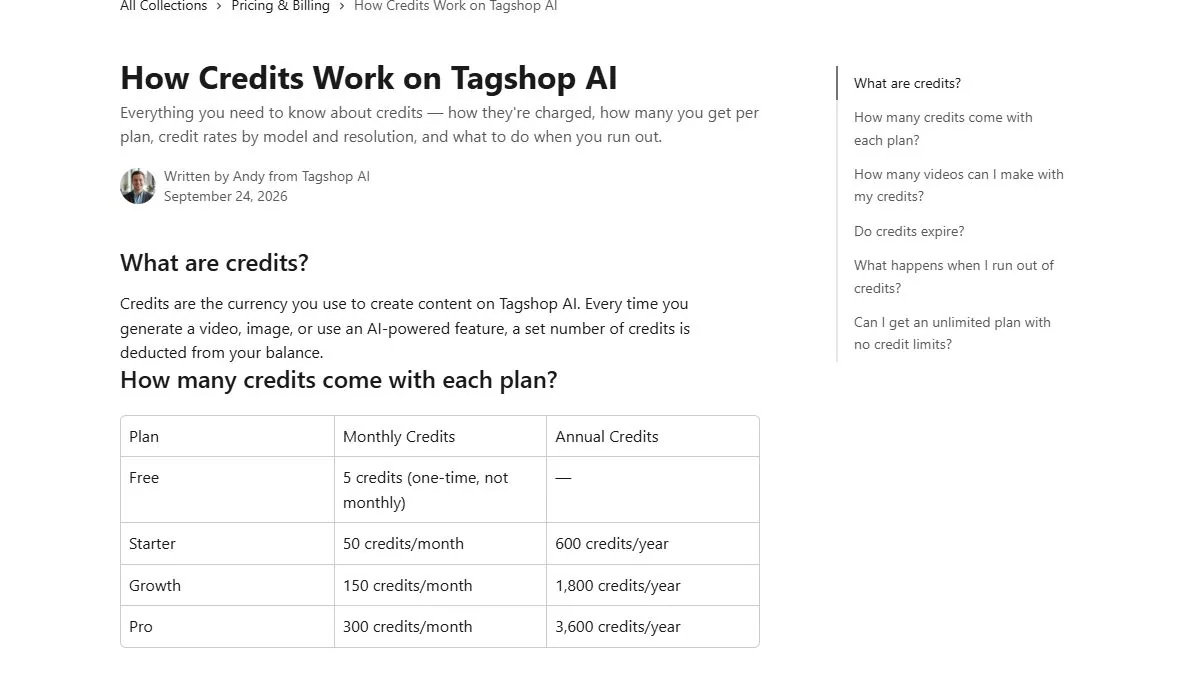
Other rules weigh on the budget. Top-ups come in packs of 20 credits (Starter) or 50 (Growth and Pro); we did not note the price of the packs. There is no unlimited plan. And unused credits are not carried over: on a monthly plan they expire at the end of the cycle, on an annual plan they stay valid all year. If your usage is irregular (a busy week of tests, then nothing), annual suits better than monthly, provided you trust the tool.
Is Tagshop AI free?
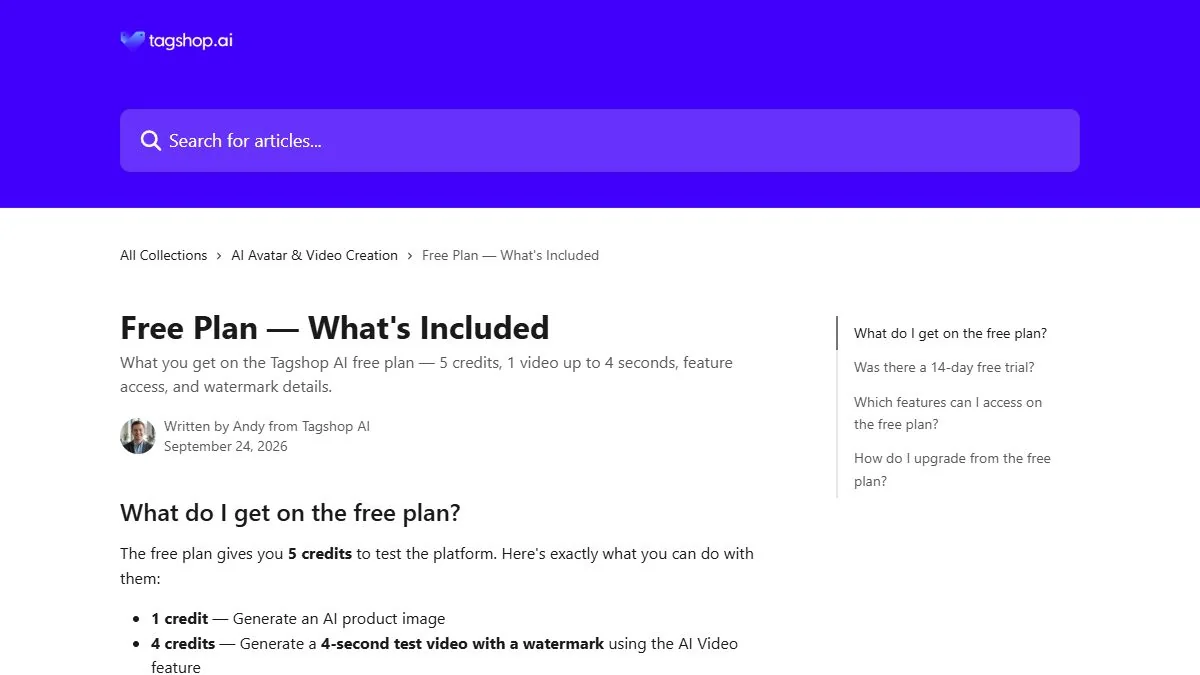
Not really. The “Free Plan, What's Included” help page (September 24, 2026) describes a free plan of 5 credits, once only (not every month). With that, you can generate a product image (1 credit) or a 4-second test video with a watermark (4 credits) through the AI Video feature. The publisher says this is “the full allocation”. The watermark disappears as soon as you move to a paid plan. The AI Twin is available, with a twin video of 15 seconds at most.
Two useful points. The 14-day free trial existed, but the publisher itself writes that any mention of a 14-day trial on the site is outdated. Another help article (a comparison with competitors, dated September 10, 2026) still talks about “a free trial”: the publisher contradicts itself, and the most recent page is the one that counts. Finally, the home page shows “No credit card required”: signing up does not require a card, again according to the publisher.
What are the announced strengths and visible limits of Tagshop AI?
What the publisher highlights
- An end-to-end workflow (idea or URL, script, avatar, voice, subtitles, scenes) that saves you from chaining five tools.
- A catalog of recent video and image models, so you can switch engines depending on your budget.
- More than 75 languages and 300 avatars, voice cloning and cloning of yourself (AI Twin).
- From Starter: 1080p export, no watermark, chat and phone support.
- A commercial-use license announced for avatars and voices, with no limit on using the ads on platforms (publisher's FAQ).
What the pages show as limits
- The real cost of an ad is hidden behind “up to 5 videos”. With the credits table, you need a calculator next to it.
- Refunds are almost non-existent. The terms (§ 5) and the help pages, read on October 31, mention fees that are “final and non-refundable”. No refund on monthly plans after purchase. An annual plan is refundable only within 3 to 7 days of purchase and only if no credit has been used. Technical problems are reviewed case by case, and dissatisfaction with quality does not entitle you to an automatic refund. This is a serious point to weigh before taking an annual plan.
- No unlimited plan, no carry-over of credits.
- A very narrow free plan : 4 seconds of watermarked video are not enough to judge an ad.
- Contradictory information from the publisher about the free trial, and a home page FAQ marked “Last updated August 2026”.
- A broad license on your content. The terms of use (in force since April 15, 2025) grant Tagshop a worldwide license on your input and output content to provide and improve the service. If your content includes a voice or a face, Tagshop says it does not commercialize it on its own without written permission.
What should we make of the publisher's figures?
The site claims +87% ROI, 10x more variations, +40% conversion, +30% CTR, and UGC that would bring “about 4 times” more clicks for 50% less cost per click. It also shows more than 143 reviews on G2 and Trustpilot with a 4.9 rating. These are claims, with no method or sample published on the pages we read. We quote them so you know what the publisher promises, not because they have been demonstrated.
Are AI-generated UGC ads legal?
In principle yes, provided the public is not misled. We are not lawyers, but a few markers apply in every case, and we have already set them out in our AI UGC guide.
- No false testimony. Making an avatar say “I have used it for six months” when nobody has used it amounts to fabricating a fake customer review. The Consumer Code punishes misleading commercial practices. An avatar can present a product, not vouch for it.
- The “Virtual images” label. The Act of 9 June 2023 on commercial influence requires this label on AI-generated images that represent a face or a body in commercial influence content.
- Platform rules. TikTok and Meta ask advertisers to label realistic AI-generated content. An unlabelled ad may be rejected.
- European AI Regulation. Transparency obligations on content generated or manipulated by AI (Article 50 of the Regulation (EU) 2024/1689) apply from August 2026, with details that may still be clarified.
- Other people's faces and voices. The AI Twin clones you. Cloning someone else without their consent exposes you to legal action: our guide on deepfakes and the law in France covers this risk in detail.
On content ownership, the publisher says its avatars and voices are licensed for commercial use. That is a statement from its FAQ, not a contract we have read in detail: read the terms of use before running a campaign, especially since the advertiser remains responsible for what it publishes, whatever the tool.
Will AI replace human UGC creators?
The publisher itself is measured. In its FAQ, it writes that AI is more practical for volume, fast iteration and multilingual work, that human creators keep the edge when authenticity is the real differentiator, and that many brands use AI for quantity and humans for “hero” content. We could not have put it better.
The price gap still explains why the question comes up. Our guide puts a human UGC video at between €150 and €350 in France in 2026, excluding extended advertising rights. Next to that, the $2.80 to $5.80 “at best” per video calculated above look tiny, even if the comparison is lopsided: an 8-second generated video is not a 40-second testimonial filmed by a real person. There are two distinct uses. AI is for testing twenty hooks in one afternoon. Humans are for carrying the winning version, or anything that must be believed: a result, a texture, a real experience.
Our take: creators are not disappearing, their work is shifting toward high-stakes ads. How good Tagshop's avatars are next to a real creator, the official pages do not say.
Who should choose Tagshop AI, and who should skip it?
- An e-merchant or dropshipper who wants to produce many variants from product pages: the profile the publisher targets. Growth ($39 per month on annual billing) or Pro are the plans that make sense; Starter leaves little room.
- An agency who delivers creative tests to clients: Pro's 300 credits and the custom plan are built for it. Check the license and data retention.
- A software or app publisher : an avatar presenting a service does better than an avatar handling a physical product.
- A solo creator or the simply curious : the 5 free credits are not enough to form an opinion. Take a tool whose free plan gives more, such as Creatify, or look at Arcads if realism matters more than price.
- A brand that needs real testimonials (health, finance, quantified results): an avatar is not the right answer, here or anywhere else.
If your need is more of a presentation or a company avatar than a UGC-style ad, our page on AI avatar generators and our HeyGen review are better starting points.
Verdict
Our verdict on Tagshop AI, based on its official pages
What the pages let us say: Tagshop AI offers a complete AI UGC ad pipeline with good arguments on paper (agent, Ad Clone, URL to Video, recent models, 1080p without a watermark from Starter) and an entry price of $14 per month on annual billing or $29 month to month.
What the pages do not show: that the avatars and the French are convincing, and that the credits are enough to produce real ads. According to the publisher's table, 50 credits only make one 30-second video at the recommended quality. The refund terms are strict, which argues for starting with the monthly plan, or the free credits, before any annual plan.
So we do not rank Tagshop AI among the best AI UGC tools: the publisher's pages describe features and prices, not results.
FAQ: Tagshop AI, the AI UGC ad platform
Is Tagshop AI free?
Barely. The free plan gives 5 credits, once only: one product image (1 credit) or a 4-second test video with a watermark (4 credits), according to the publisher's help page read on October 31, 2026. The 14-day trial no longer exists. Subscriptions start at $29 per month, or $14 per month billed annually.
How much does Tagshop AI cost in 2026?
Prices read on October 31, 2026, in dollars: Starter $29 per month ($14 on annual billing, 50 credits per month), Growth $69 ($39, 150 credits), Pro $129 ($79, 300 credits). Credits are charged per second of video depending on the model: 50 credits make roughly one 30-second video in Seedance 2.5 720p, according to the publisher's table.
Can you get a refund on a Tagshop AI subscription?
Very rarely. The terms read on October 31, 2026 state that fees are non-refundable. A monthly plan is never refunded after purchase. An annual plan is refundable only within 3 to 7 days of purchase, and only if no credit has been used. Technical problems are reviewed case by case.
Does Tagshop AI work in French?
The publisher announces more than 75 languages, including French. No publisher page details the quality of voices, scripts or subtitles: ask for an excerpt in French before committing.
Are AI-generated UGC ads legal?
In principle yes, as long as they do not mislead the public. Avoid fake testimonials, flag virtual images when the law requires it, label AI content according to platform rules, and never clone someone's face or voice without consent. We are not lawyers: check your own case.
Is Tagshop AI reliable?
The publisher displays 4.9 on G2, more than 5,000 brands and more than 143 reviews, figures it reports itself and that we have not verified. What can be seen on its pages: clear prices, but strict refund terms and an internal contradiction about the free trial.
Can Tagshop AI replace human UGC creators?
Not entirely. The publisher admits that AI is more practical for volume and multilingual work, and that human creators keep the edge when authenticity matters. Many brands use AI to test at scale and humans for their main content.