Suno became the name that comes to mind as soon as we talk about music generated by artificial intelligence. You type a description in one sentence, and two minutes later you have a complete song, with voice, instruments and couplet-refrain structure. The promise is spectacular, and it stands technically. The real question, whether you have to pay or not, is about the rights: what can you do with the pieces once they are created?
That's where 2026 changes the deal. Suno emerged from a major judicial conflict with the record companies, signed an agreement with Warner Music, and announced a redesign of his models. This review takes stock of what is really in effect today, what is only announced, and what you risk if you confuse both.
💡 Essential in 30 seconds
- Free: 50 credits per day, or about 10 securities. Listening and sharing allowed, commercial use prohibited.
- Pro: 8 $ annual monthly, 2,500 credits, trade rights on new pieces, WAV export.
- The trap: going to the payee does not give any rights to songs already created free of charge. They remain unmonetable for life.
- For whom: excellent for fast creation and personal use. For a serene monetization, a trained alternative on licensed catalogue is more cautious.
How Suno works, and who's behind
Suno is an American company based in Cambridge, Massachusetts, founded in 2023 by a vocal recognition team. The principle is one line: you describe a song in natural language, and the model produces a complete audio, including voice.
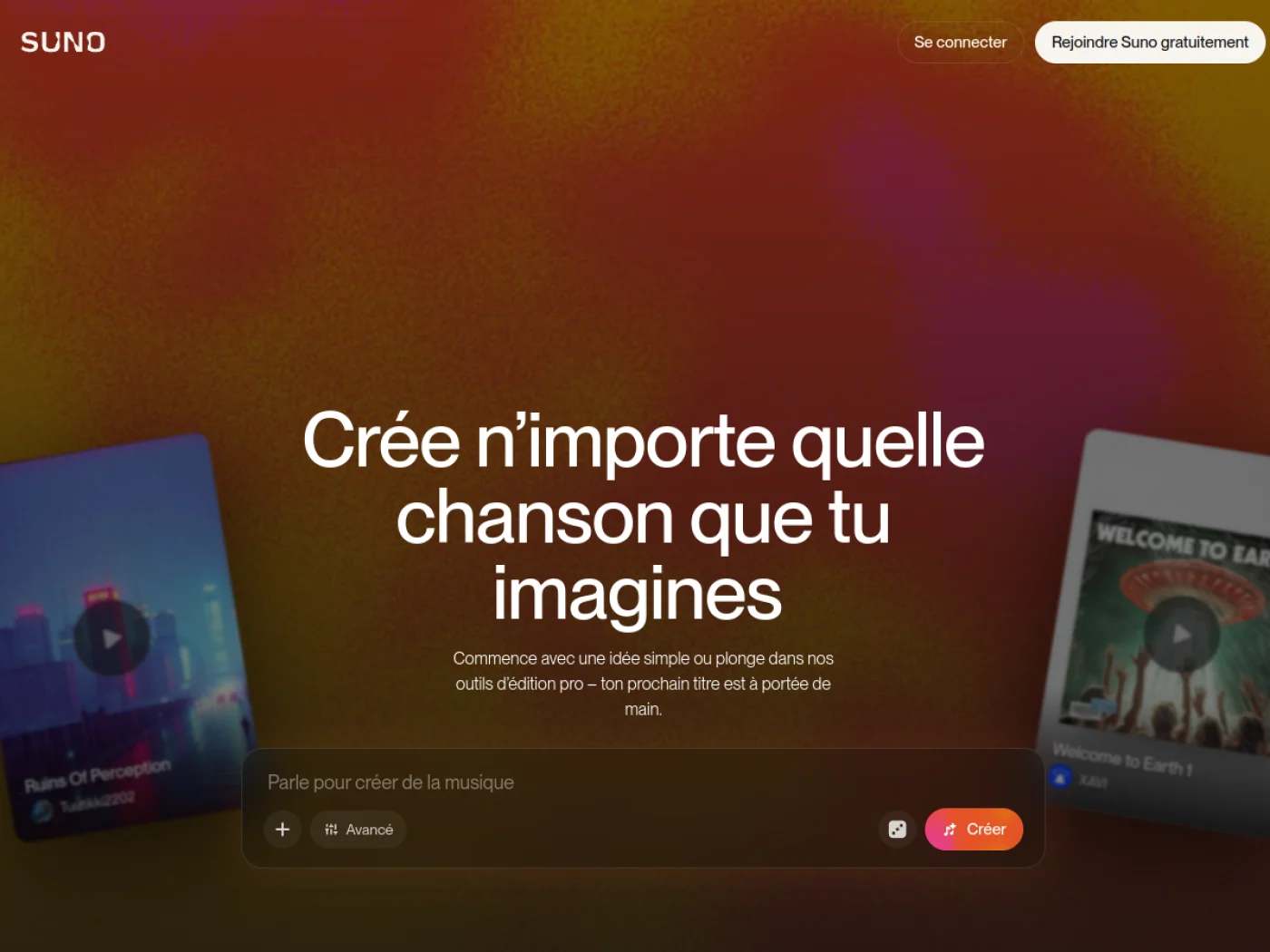
Two modes coexist. Simple mode takes a free description, for example « a melancholic folk ballad with an acoustic guitar and a female voice ». The advanced mode separates lyrics, musical style and title, which gives much more control. You can write your own lyrics, let the template generate them, or from lyrics produced by an assistant like ChatGPT.
Important point for the French-speaking public: French singing works properly, which has not always been the case. The pronunciation remains perfect on rare words and links, but we are very far from the approximate renderings of the first versions.
The credit system, explained simply
Everything counts in credits, and the calculation often fails. A generation costs 10 credits and produces two variants of the same piece. In other words, 50 daily credits give 5 generations, or 10 tracks to listen to a day.
Two rules to be adopted from these appropriations. Appropriations linked to a subscription do not report one month on the other: what is not consumed is lost. Credit purchased in addition does not expire, but requires an active subscription to be usable. That means freezing the credits you paid.
The free plan: what it really allows
Yes, Suno is usable for free, and generously. But free is about creation, not exploitation. It is the nuance that costs dearly to those who discover it too late.
| What the free plan allows | What it prohibits |
|---|---|
| 50 credits renewed each day, or about 10 titles | Any commercial or monetized use |
| Access to the v6-mini model | Access to v6 and v6-wild models |
| Link sharing to the song page | Distribution on Spotify, Apple Music and others |
| Listen online to generated songs | Any download (« No monthly song downloads ») |
| Audio import up to 8 minutes | Separation of instrumental and vocal tracks |
| Shared generation file | Priority file and simultaneous generations |
The biggest line of consequences is the first. Official documentation of Suno is explicit: pieces created without subscription are intended for personal and non-commercial use, and cannot be monetized. Another page even specifies the question of ownership On a free level, Suno owns the pieces, you only have a non-commercial use right.
Concretely, background music on a video YouTube Monetized is already out of the picture. Same for sponsored podcast dressing, advertising, or a piece sold on a platform. If your project earns money, even indirectly, the free plan is not enough.
Pro and Premier rates: detail
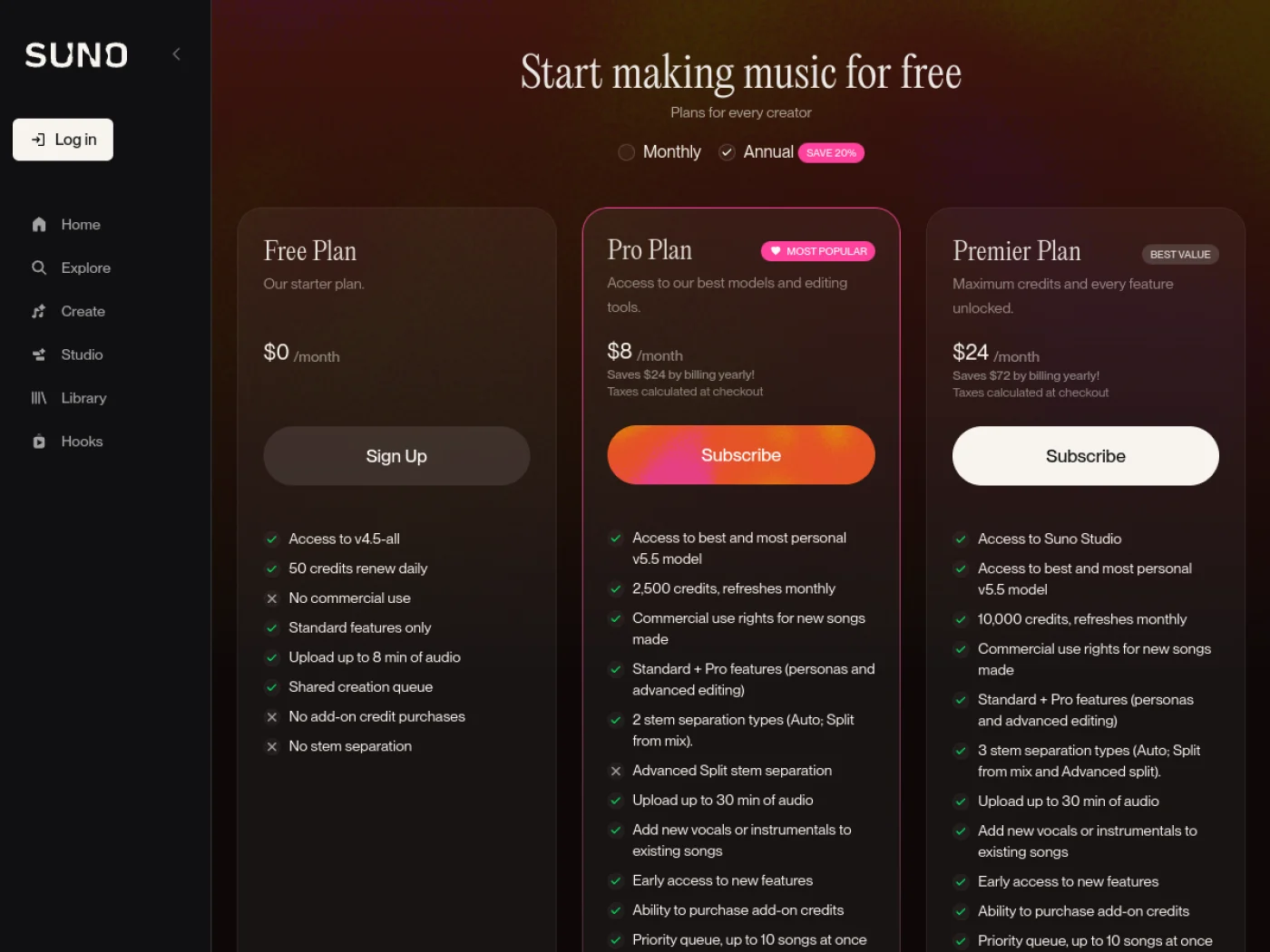
Rates are displayed in dollars, excluding taxes added to the payment. The amounts below are the annual invoice, the only default displayed. Suno announces an economy of 24 $ per year on Pro and 72 $ per year on First compared to monthly payment, which puts the monthly around 10 $ and 30 $.
| Plan | Annual price | Credits | Estimated securities | Key points |
|---|---|---|---|---|
| Free | 0 $ | 50 per day | ~10 per day | Model v6-mini, no commercial rights, no download |
| Pro | 8 $ per month | 2,500 per month | ~500 per month | V6 and v6-wild models, commercial rights, 20 downloads per month, 2 runway separation modes, import 30 min, priority queue |
| First | 24 $ per month | 10 000 per month | ~2,000 per month | All Pro, 60 downloads per month, plus Suno Studio and a 3rd mode of separation |
For the vast majority of uses, the Pro plan is the right choice. The 2,500 monthly credits represent about 500 titles, a volume that very few creators reach. First is justified only by Suno Studio, the advanced publishing environment, and by the third mode of separation of tracks that interests those who seriously remix.
The separation of tracks deserves a word because it is an underestimated criterion. It allows to isolate the voice of the instrumental. Without it, you recover a frozen file, impossible to rework in a video editing software. With it, you can adjust the mixing, replace an element, or use only the instrumental under a voiceover. It's missing from the free plan.
Rights, Resale and Spotify: The Trap of Retroactivity
This is the section to read before paying, because it contains the most expensive and least known error.
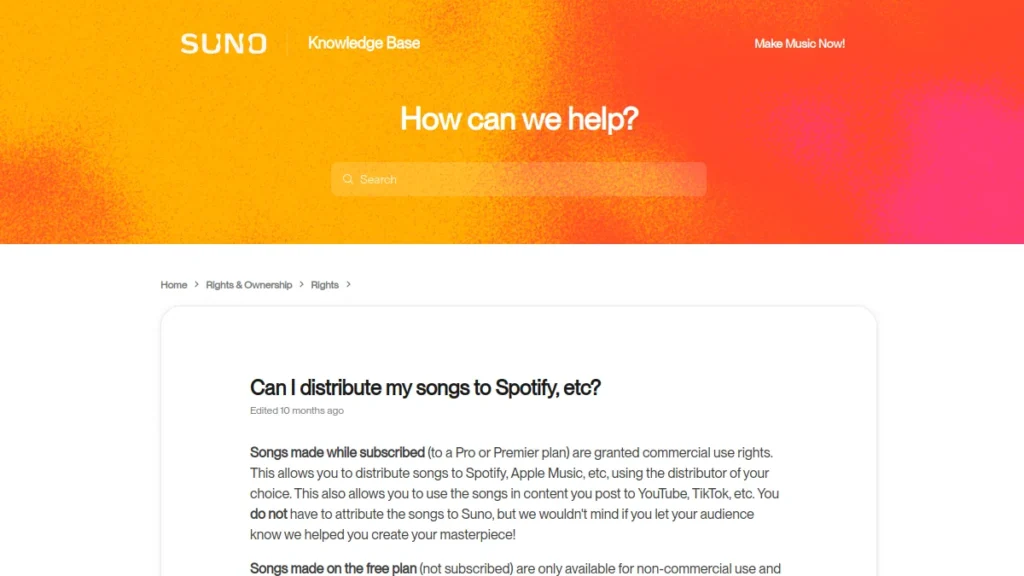
⚠️ Fees are not retroactive. If you create thirty pieces free of charge, then subscribe to the Pro plan, these thirty pieces remain non-marketable. Subscription opens rights to created titles after subscription, never before. You have to regenerate them once you have subscribed.
This rule is confirmed black-on-white by Suno, which states that switching to a subscription does not confer retroactive trade rights on previously created pieces. The reflex to take is therefore simple: if you are seriously testing for a project, take the subscription before produce the pieces you intend to exploit.
Publish Spotify and Apple Music
Suno explicitly allows streaming distribution, but only for products under Pro or Premier subscription, via the distributor of your choice. Credit Suno remains optional.
A warning accompanies this authorization, and it is important: you must be the sole owner of all the equipment used. Resuming existing words, even partially, exposes to the suppression of distribution and blacklisting in distributors. Generate a Song « in the manner » such known artist and publish it therefore remains a very bad idea, regardless of what the model agrees to produce.
The trial and the Warner agreement: what changes in 2026
In June 2024, the main US record companies, gathered behind the RIAA, attacked Suno and his competitor Udio for copyright infringement. The complaint concerned the training of models from protected recordings. This is the answer to the question many people are asking themselves when they discover thattool Why is Suno being prosecuted?
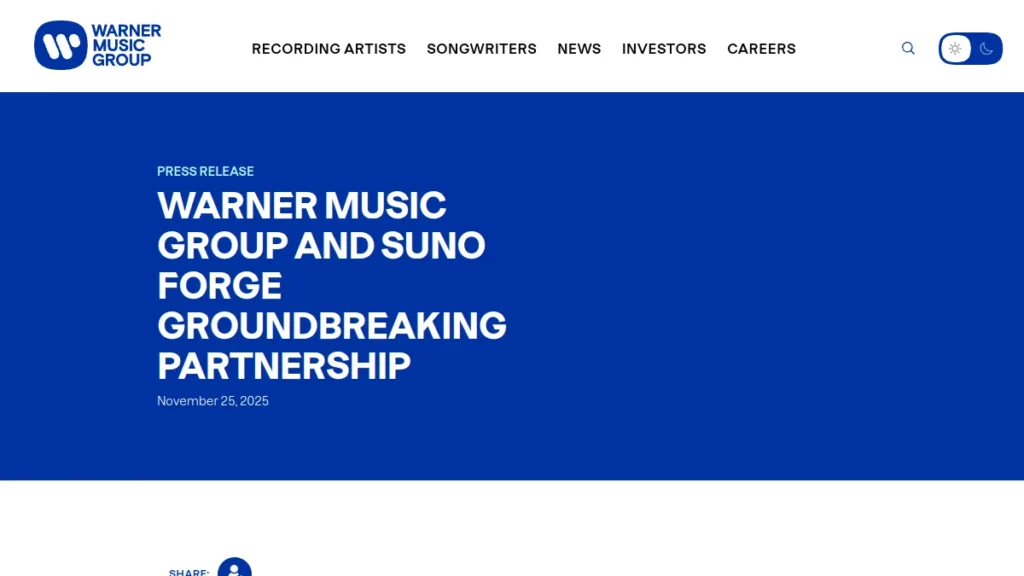
The file turned on November 25, 2025. Warner Music Group announced a licence agreement with Suno, which ends his dispute. The content of this agreement draws the Suno of tomorrow.
- Licensed models. Suno is committed to launching in 2026 new models trained on licensed catalogues, and gradually removing current models.
- An artist's consent. Artists and authors gain control over the use of their name, image, voice and compositions in the generated songs.
- Download restrictions. The agreement provides that the pieces of the free plan become non-downloadable, and that paid subscribers are subject to monthly download ceilings.
💡 Announced, then applied. In July 2026, Suno's documentation still described a free MP3 download. This is no longer the case: as of October 11, 2026, the tariff page indicates « No monthly song downloads » for the Free plan, and quotas of 20 downloads per month in Pro and 60 in Premier.
Two points remain outstanding, and they count on risk assessment. The Warner deal does not resolve everything: the proceedings brought by Universal and Sony against Suno do not have a fixed trial date. And the predicted depreciation of current models means that the pieces you produce today are based on a technology that will disappear.
Should we run? No. But if your project is commercial and intended to last, this uncertainty has a real weight, and it justifies looking at what the tools trained from the outset on licensed catalogues.
The flight of July 2026: what it reveals
This section was added on July 21, 2026, after revelations that change the way the service is valued. They are too recent to be included in most online comparisons.
⚠️ Two separate cases, not to be confused. One side one leak of personal data for user accounts. On the other hand, the publication of source code Suno, who documents how his models were trained. The second is the greatest of consequences.
The leak of user data
According to analyses published in July 2026, personal data of the order of 55 million accounts These included names, telephone numbers, mailing addresses, purchase history and partial payment card items. The intrusion would date from November 2025, but was only released in July 2026, a period of several months.
Suno claims that no sensitive customer information, including any exploitable payment element, was compromised. If you have an account, the reflex remains the same as for any leak: change the password, and especially do not reuse it elsewhere.
Source code, and what it documents
This is the most significant aspect. On 15 July 2026, the specialized press reported the source code decodes the sources used to drive the models, with encrypted volumes.
| Source | Documented volume |
|---|---|
| YouTube Music | 2,013,545 extracts, or approximately 113,879 hours |
| YouTube Music (play tagged) | 152 162 hours |
| Pond5 (sound bank) | 62 117 hours |
| IMSLP Partition Library | 19 514 hours |
| Genius | 17 615 hours |
| Deezer | 12 287 hours |
| Podcasts | about 420,000 targeted flows |
Two technical details are particularly important. The code would reveal the use of relay servers to aspire YouTube, which amounts to bypassing the platform's protections. And he would show a targeting of a cappella versions, whose interest is to isolate the voices for learning.
Suno replied that his models were trained on music files publicly accessible on third-party sites, and that the exposed code is an old version, which is no longer in use.
Why it changes the legal situation
So far, the central charge of record companies was based on a deduction: the models produced results that suggested training on protected recordings. The code documents the collection.
The amounts involved are becoming considerable. The complainants claim up to $150,000 per work, and if the procedure were to be extended to the tens of thousands of records identified, the total would exceed several billion dollars. Warner settled his dispute at the end of 2025, but that Universal and Sony procedures remain pending.
What this means to you, in practice
Let us be measured: none of this makes it illegal to use Suno today, and the pieces produced under subscription remain covered by the commercial conditions described above. The service works normally.
But uncertainty about the future of service is increasing significantly. If you are considering a sustainable business project in Suno, know that you are relying on a company whose training model is challenged in court, with amounts that could affect its survival. For one-off or creative use, the risk remains theoretical. For an activity that must last years, prudence requires diversification, or choice of tool trained on catalogue licensed from the outset.
Once the song is generated, remain the image. Explain how to turn a song into a music clip with AI, with sync on beat, lyrics on screen and lip sync.
Alternatives, including a commercially usable equivalent
The question « what is the free equivalent of Suno » Come back constantly. The honest answer is that tool offers both the quality of Suno, free, and commercial rights. However, depending on what you're really looking for, there are two tracks on the road.
A final element of comparison, which puts these limits in perspective. Its direct competitor has gone much further: Udio has deactivated any download at the end of 2025 after his agreement with Universal, and has still not re-established them. We find this in our review on Udio, useful to understand what the sector is heading towards.
Mubert, if you want more music royalty-free
Many people arrive on Suno looking in reality for background music for a video, without the need for lyrics or singing. In this case, Mubert responds better to the need: the service generates instrumental tracks designed from the start for commercial use, thus avoiding the entire grey area of rights.
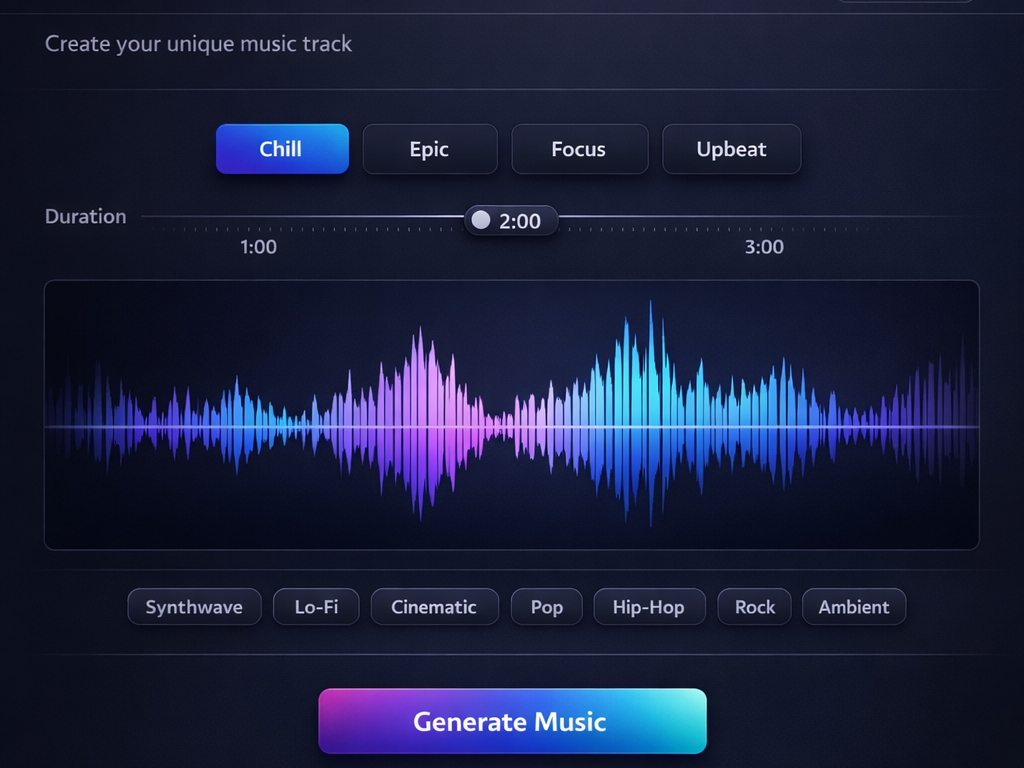
The compromise is clear: you lose the complete song with voice, which remains Suno's great strength, and you gain legal tranquility. We detail its operation and its limitations in our review complete on Mubertand in our guide on music AI royalty-free for YouTube.
Need music commercially usable without a grey zone?
Mubert generates leads royalty-free, thoughts for video and podcast.
ElevenLabs, if voice counts as much as music
ElevenLabs, especially known for voice synthesis, also offers a musical generation. Its central argument is that the tracks are announced as being driven on commercially licensed and usable data, with restrictions for cinema, television and games on self-service formulas.
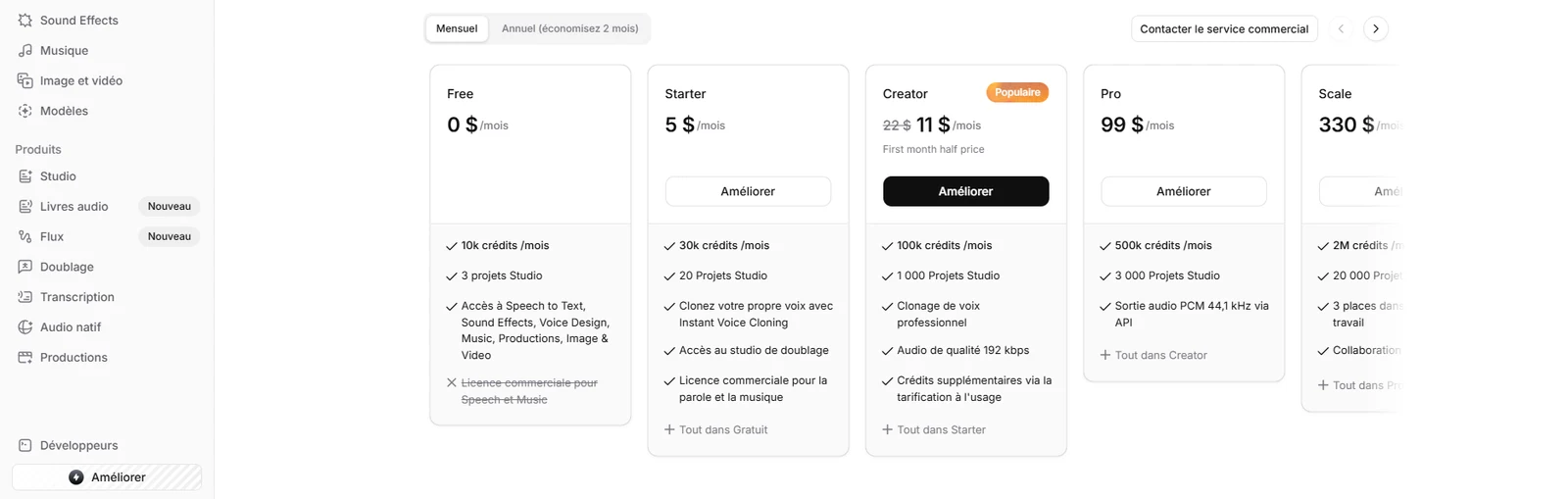
It's the logical choice if your production mixes voiceover and musical dressing, since you stay in one tool. Our review complete on ElevenLabs details the vocal part, by far the most accomplished.
If you still hesitate between several solutions, our guide of the AI generators Music free compares the main options and their actual conditions of use.
Our verdict on Suno
Suno remains, in July 2026, the generator by AI the most convincing of the market on a purely creative level. No competitor produces a song so quickly structured and sung from a single sentence, and the quality in French has improved significantly.
| Suno suits you if | Go your way if |
|---|---|
| You want to create complete songs with voices and lyrics | You are only looking for instrumental background music |
| Your use is personal, playful or experimental | You need strong long-term legal guarantees |
| You agree to pay 8 $ per month to obtain rights | You planned to do everything for free and then monetize. |
| You want the best quality level available today | The forecast depreciation of the current models bothers you |
Our recommendation is in two stages. Test the free plan to judge the quality on your own styles, knowing that these tracks will never be commercially exploitable. Then, if the result convinces you and the project is commercial, subscribe to the Pro plan. before produce the final securities. This simple precaution avoids the most frequent and irreversible error.
Frequently asked questions about Suno
Is Suno AI free?
Yes, with a free plan offering 50 credits renewed each day, or about 10 daily titles. The creation is free, but the exploitation is not: the pieces produced without subscription are reserved for personal use and cannot be monetized.
Can I sell a song I wrote on Suno?
Only if it was created while you were a Pro or Premier subscriber. Commercial rights are not retroactive: a piece generated free of charge is not monetizable even after subscription. You have to regenerate it once you subscribe.
Is Suno allowed on Spotify?
Yes, Suno allows distribution on Spotify, Apple Music and other platforms, for songs created under subscription, via the distributor of your choice. However, you must be the sole owner of all the material used, which excludes any repetition of existing words.
Why is Suno prosecuted?
The record companies gathered behind the RIAA attacked Suno in June 2024 to train his models on protected recordings. Warner Music settled its dispute on November 25, 2025 with a licence agreement, but the proceedings of Universal and Sony against Suno remain pending, with no fixed trial date.
What is the free equivalent of Suno?
None tool combines Suno quality, free of charge and commercial rights. If your need is for instrumental tracks royalty-freeMubert responds better. If you are looking for the song sung, direct competitors like Udio apply comparable restrictions on their free formulas.
Are unused Suno credits lost?
Credits included in one subscription do not refer to the other month. Credits purchased in addition do not expire, but they require an active subscription to be used, making them inaccessible if terminated.
Can we download his parts in WAV?
The WAV format is reserved for Pro and Premier subscribers, and the download must be done from the site and not from mobile, which systematically returns an MP3. The free plan no longer allows any download: the price page indicates « No monthly song downloads », and Pro and Premier subscribers have 20 and 60 downloads per month respectively.