Let's start with what blocks half the research on the subject: Veo 3 no longer exists. Google adopted this model on 30 June 2026. The guides which explain how to get free describe something you can no longer use.
The model in service today is Veo 3.1. It is accessible without paying, but not everywhere or without consideration, and the gap between what Google official document and what the pages that sell the « Free Veo Unlimited » is considerable. This is what is verifiable.
📌 Essentials
- Veo 3 has been arrested since 30 June 2026. The current model is Veo 3.1.
- On API, free does not exist: Google indicates black on white that Veo is not available in free level.
- Access without payment exists via Gemini, Flow and AI Studio, but Google does not publish quotas.
- All videos carry SynthID, an invisible watermark that cannot be removed.
- By paying for: from 0.05 to 0.60 $ the second according to model and definition, including audio.
Contents: The judgment of Veo 3 • The four accesses • Flow and Google Vids • Which is really free • SynthID Watermark • Prices per second • Subscriptions • Competition • FAQ
Veo 3 is stopped, Veo 3.1 is replaced
Official documentation Google is explicit: Veo 3 is marked as deprecated, with a date of extinction fixed at 30 June 2026. That date has passed. If you are looking « Free Veo 3 », you are looking for a model that is no longer served.
Veo 3.1 takes over the torch, and most of what made the reputation of the range. Videos make 8 seconds, output in 1080p or 4K, and especially audio is generated at the same time as the image. Dialogues, noise and atmosphere arrive synchronized, without post-treatment. It is Veo's real technical signature against its competitors, most of whom deliver mute sequences.
💡 Tip: to exceed 8 seconds, it is necessary to chain several generations and connect them to the editing. No adjustment allows to produce a longer plane at once.
The four entrance doors to Veo
This is the main source of confusion. « Veo » is not a unique product but a model exposed in four different environments, with different conditions. Many guides mix the four and draw false conclusions.
| Access | What it is | For whom |
|---|---|---|
| Gemini | The general public assistant, where video generation is one of many functions | Occasional use, discovery |
| Google Flow | A studio designed for narration, with plan and sequence management | Creators and directors |
| Google AI Studio | The test workshop in the browser, oriented prototyping | Quick try, developers |
| API (Vertex AI, Gemini API) | Programmatic access, billed at the second | Integration into a product |
Keep the last line above all, because it is she who settles the question of price. The API is paid, without exception. The other three environments are those where no-expenditure use is possible.
Flow and Google Vids: Veo's other two faces
Both products are based on the same model, but are not intended for the same use at all. Confounding them leads to choosing the wrong tool.
Google Flow, to tell a story
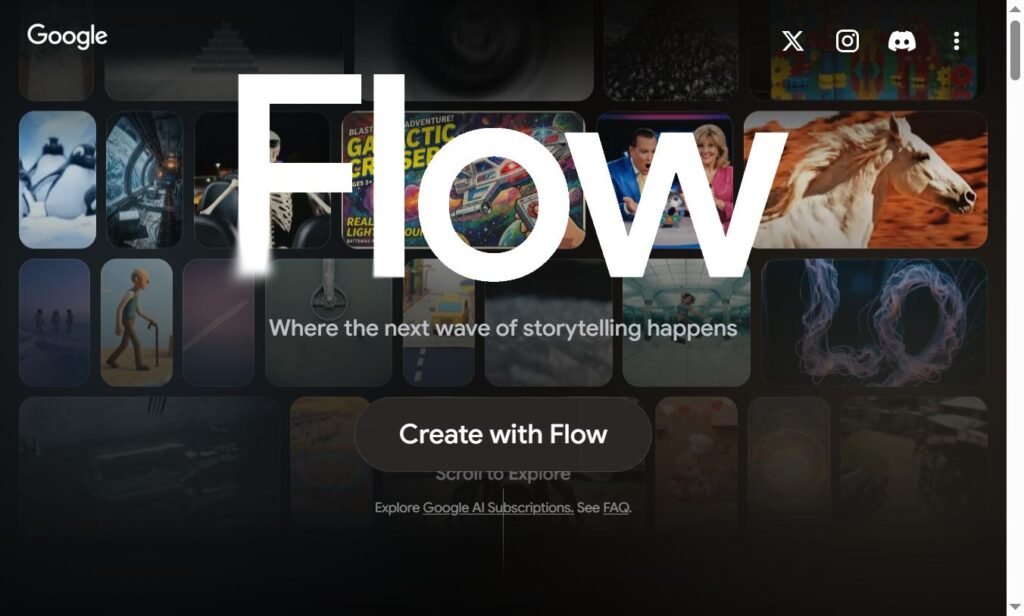
Flow is the only one of the four environments designed for narration. You work in successive planes, with a continuity of characters and scenery from one sequence to another, and camera controls close to the cinema vocabulary: travelling, panoramic, fixed plane. This is where it goes when the lens is a mounted sequence, not an isolated clip.
It is also the most resource-intensive environment, so the one where the quota goes as fast as possible. Frame your intention before starting generations.
Google Vids, for work video
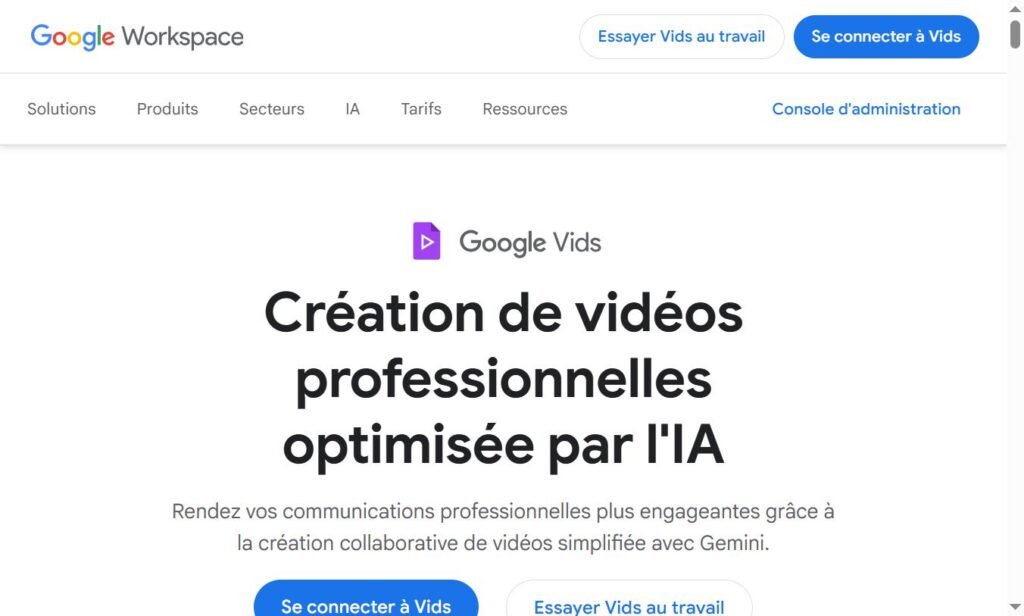
Vids plays a completely different score: integrated in Workspace, alongside Docs and Slides, it aims at video utility. Business presentation, training module, internal message. It is based on a document or a plan, andtool built a structured video, with voiceover and subtitles.
If your need is a business communication medium rather than a film plan, it is to Vids that you should look at, and then access depends on your Workspace license and not on the general public quotas mentioned above.
What is really free, and what Google Don't say
On this point, we must clearly separate the verifiable from the approximate, because the subject is saturated with pages that promise to the « Free Veo Unlimited ».
What is official
The pricing page of Google indicates in front of Veo that the model is not available in free level : a paid account is required. It is unambiguous, and this applies to programmatic access.
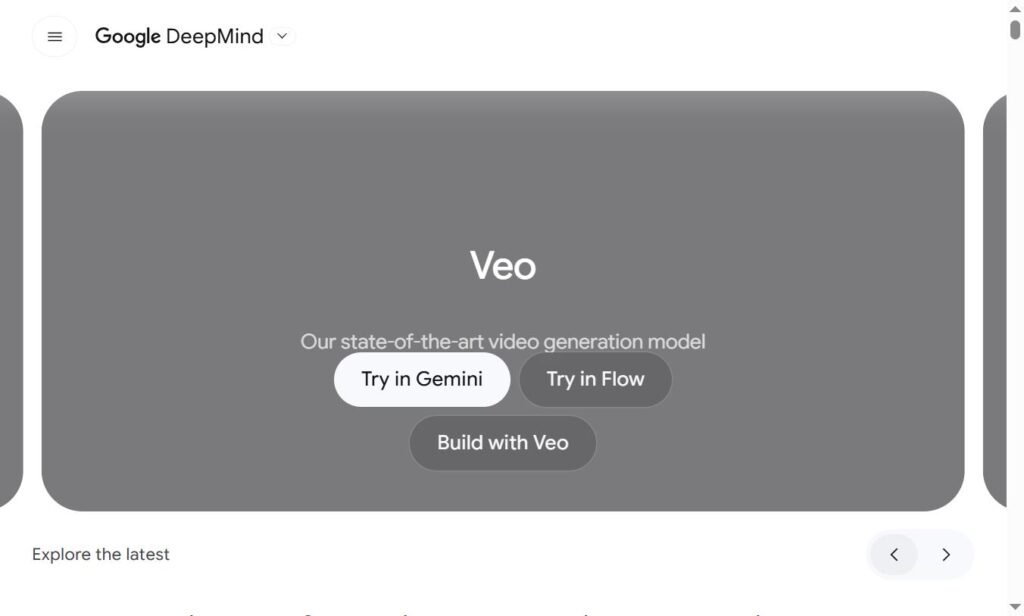
In parallel, Google displays many buttons « Try in Gemini », « Try in Google Flow » and « Try in Google AI Studio » on its product page. So there is a real use without a credit card, but it goes through these interfaces, not through the API.
What's not
⚠️ Attention: Google does not publish an encrypted free quota for Veo. Its documentation refers to the dashboard of your account for your limitations. The figures that circulate (10 videos per month, 12 per day, 50 daily credits) come from blogs, between them, and are not officially confirmed anywhere. We're not taking them back.
Reasonable conduct is twofold. First, consider the free as a variable test right, which can change without prereview and according to regions, not as a resource on which to build regular production. Then go read your real limits in your own account: this is the only number that concerns you.
This reflex extends beyond Google. We saw closely with the sudden closure of a major competitor, detailed in our article on Sora's stop : in the general video, free access is a commercial decision, not an acquis.
SynthID: All your videos are marked
Often passed in silence, yet decisive according to your usage. Google DeepMind clearly states : videos produced with Veo are marked with SynthID, its watermarking technology and the detection of content generated by AI.
This marking is invisible to the eye, recorded in the file itself, and detectable by tools dedicated. It is not a logo that a cropping would disappear, and it does not depend on your formula: it concerns all outputs, free as well as paid.
In concrete terms, this means that a Veo video is identifiable as generated by AI, lasting. For an assumed creative use, no importance. If your project was based on making the result look like a real capture, it's a wall. And from 2 August 2026 onwards, transparency on the content generated becomes in any case an obligation in Europe, a point which we detail in our guide on the legal framework of content AI in France.
Real prices, second
If you go through the API, the billing is done on the second of the video produced, and Audio is included in these rates. Google does not charge the generation that fails: only a video produced successfully is counted.
| Model | 720p | 1080p | 4K |
|---|---|---|---|
| Veo 3.1 Standard | 0,40 $ | 0,40 $ | 0,60 $ |
| Veo 3.1 Fast | 0,10 $ | 0,12 $ | 0,30 $ |
| Veo 3.1 Lite | 0,05 $ | 0,08 $ | Not proposed |
Returned to a plan of 8 seconds, it gives about 3.20 $ Standard 1080p, 0.96 $ in Fast, and 0.64 $ In Lite. The gap between Standard and Lite is an eight factor, which changes everything as soon as you produce in series.
The right reflex is to iterate in Lite or Fast to set your speed and scoping, then launch the Standard only on the final version. Many budgets go into smoke on tests charged at the high rate.
Gemini, Flow and subscriptions Google AI
Apart from API, extended access is via subscriptions Google AI, which give more comfortable generation volumes in Gemini and Flow, with access to the fastest or most faithful variants depending on the level subscribed.
We do not detail here the quotas associated with each formula, for the same reason as above: Google changes these volumes regularly and does not document them with the same accuracy as its API rates. The values displayed in your account at the time of subscription are true, and they are the only ones to check before paying.
A benchmark, however, to arbitrate: if your need is limited to a few videos a month, the free trial in Flow or AI Studio will suffice. If you produce regularly, compare the cost of subscription to the price per second of the API, which quickly becomes more economical on the Fast and Lite variants.
Veo faced with competition, after Sora's disappearance
The landscape changed sharply in 2026. The most commented competitor, Sora, was closed by OpenAI, which leaves Veo in a dominant position on mainstream video, alongside Kling.
| Criteria | Veo 3.1 | Kling | Sora |
|---|---|---|---|
| Available in France | Yes | Yes | No, closed service |
| Native Synchronised Audio | Yes | No | Not applicable |
| Duration per plan | 8 seconds | Up to 15 seconds | Not applicable |
| Use without payment | Yes, quota not published | Yes, daily credits | Not applicable |
| Invisible watermark | SynthID on all outputs | The formula | Not applicable |
Native audio remains Veo's strongest argument: no direct competitor produces dialogue and atmosphere at the same time as the image with this level of synchronization. In front, Kling AI offers longer plans and a rendition of movement often considered superior, as we detail in our review. For an overview of the available options, our comparison video software AI review the market.
Our verdict
🎯 Verdict
Veo 3.1 is today the video generator the most accomplished available from France, and its synchronised audio did not match. Free is available, but it is a test right with unpublished limits, not a production resource. If you need to deliver regularly, take the principle that you will pay, and arbitrate between subscription and billing per second depending on your volume. Finally, remember SynthID: your videos will remain identifiable as generated by AI, and from 2 August 2026 it is anyway the rule in Europe.
Frequently Asked Questions
Is Veo 3 free?
The question no longer arises: Veo 3 was arrested on 30 June 2026. The current model is Veo 3.1. On the API, Google indicates that it is not available in a free tier and that a paid account is required. Use without paying remains possible via Gemini, Google Flow and Google AI Studio, but quotas are not published.
How much does Veo 3.1 cost?
On the API, the invoicing is one second of the video produced, including audio: 0.40 $ Standard 720p and 1080p, 0.60 $ in 4K, 0.10 to 0.30 $ in Fast as defined, and 0.05 to 0.08 $ In Lite. A plan of 8 seconds is therefore about 3.20 $ Standard 1080p versus 0.64 $ In Lite.
How many free videos a day with Veo?
Google does not publish this figure. Its documentation refers to the dashboard of your account to find out your actual limits. The values that circulate online contradict each other and are not confirmed by any official source: check directly in your account.
Do Veo videos have watermarks?
Yes. Google DeepMind indicates that all videos produced with Veo carry SynthID, an invisible tagging recorded in the file data and detectable by tools dedicated. It does not depend on your formula and cannot be removed by cropping.
What is the maximum duration of a Veo video?
Eight seconds a generation. To get a longer sequence, you have to chain several planes and connect them to the editing. The available resolutions are 1080p and 4K.
Is Veo available in France?
Yes, unlike Sora, which was never officially opened in France and whose service closed in April 2026. Veo is accessible via Gemini, Google Flow, Google AI Studio and API.